

GHK-CU, Healing & Regeneration, Peptides
GHK-CU Peptide for Hair Growth Research: Mechanisms and Current Studies
Summarize the article with:
 ChatGPT
 Claude
 Perplexity
 Google AI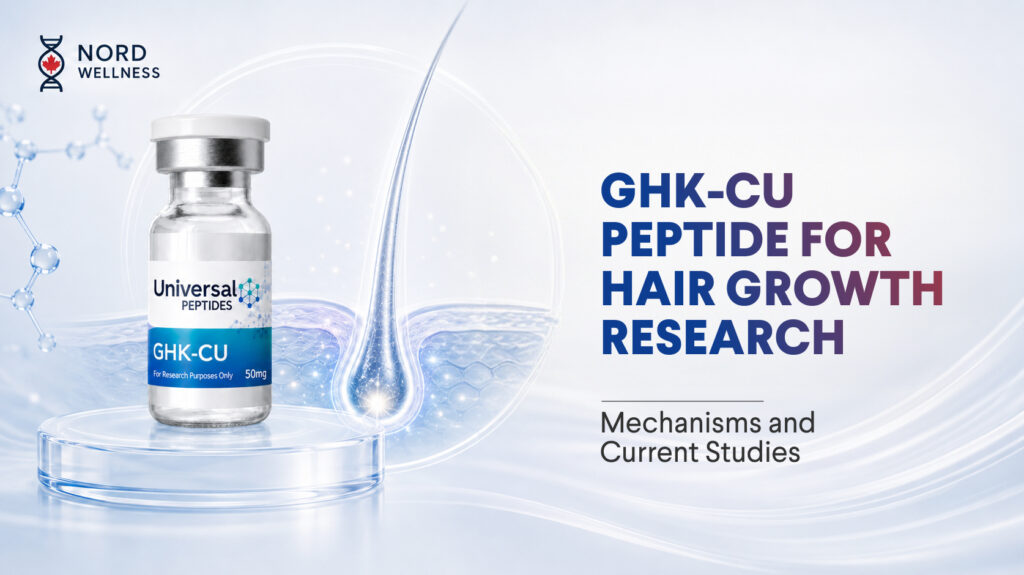
Aug
The GHK-CU peptide for hair growth research has attracted scientific interest because hair follicles depend on complex interactions between cells, signaling molecules, connective tissue, and the surrounding extracellular matrix. GHK-Cu is a naturally occurring copper-binding tripeptide studied for its potential relationship with follicular activity, cellular signaling, extracellular matrix remodeling, and tissue repair.
Although researchers have studied GHK-Cu across tissue remodeling and regenerative biology, direct clinical evidence for hair growth remains limited. Therefore, its role in hair follicle biology remains an active area of investigation. For more research-focused information about GHK-Cu, peptide mechanisms, and scientific applications, explore the educational resources available through Nord Wellness.
Why GHK-CU Is Studied for Hair Growth
Hair follicles are dynamic structures that repeatedly move through growth, transition, and resting phases. Therefore, hair research examines much more than the visible hair shaft.
Scientists investigate communication between follicular cells, dermal tissue, signaling molecules, extracellular matrix components, and local vascular structures. Changes within this biological environment can influence how follicles function.
The GHK-CU peptide for hair growth research is particularly interesting because several biological activities associated with copper peptides overlap with these processes.
| Research Area | Scientific Interest |
|---|---|
| Follicular biology | Cellular activity within and around hair follicles |
| Cellular signaling | Communication between cells and molecular pathways |
| Extracellular matrix | Structural environment surrounding follicles |
| Tissue remodeling | Maintenance and organization of follicular tissue |
| Oxidative biology | Cellular stress and protective responses |
However, overlap between these mechanisms and hair biology does not prove that GHK-Cu promotes hair growth in humans. This distinction becomes especially important when interpreting early laboratory findings.
The Role of Copper in Hair Research
Copper is an essential trace element that participates in numerous enzymatic and cellular processes. GHK can coordinate copper ions, forming the biological complex commonly called GHK-Cu.
As a result, researchers investigate whether this copper-peptide interaction influences cellular environments relevant to tissue maintenance and follicular biology.
Still, researchers should distinguish this mechanistic rationale from demonstrated treatment efficacy. Copper binding explains why scientists investigate GHK-Cu, but it does not by itself establish a hair-growth effect.
Explore GHK-CU Peptide for research purposes at GHK-CU Peptide
Potential Biological Mechanisms
No single pathway fully explains the proposed relationship between GHK-Cu and hair biology.
Instead, researchers examine several interconnected mechanisms. These include follicular cellular activity, extracellular matrix regulation, tissue signaling, oxidative responses, and the local environment surrounding hair follicles.
Hair Follicle Cellular Activity
Hair follicles contain multiple cell populations that communicate throughout the hair cycle. Among them, dermal papilla cells play an important role in regulating signals associated with follicle development and cycling.
Consequently, researchers studying copper peptides are interested in whether GHK-Cu-related signaling can influence the cellular environment surrounding follicles.
A simplified research model looks like this:
GHK-Cu → cellular signaling → follicular environment → measurable biological response
This model represents a research hypothesis rather than a proven clinical pathway.
Extracellular Matrix Remodeling
The extracellular matrix provides structural support around cells and contributes to the organization of tissues surrounding hair follicles.
Rather than remaining static, this matrix continually undergoes production, breakdown, and reorganization. GHK-Cu research in other tissue models has generated interest in its possible relationship with these remodeling processes.
Therefore, the GHK-CU peptide for hair growth research may involve more than direct effects on follicular cells. Researchers may also examine changes in the surrounding tissue environment.
Tissue Repair and Cellular Signaling
GHK-CU has a broader research history involving tissue repair and regenerative biology. Scientists have investigated its interactions with processes such as cellular signaling, extracellular matrix organization, and responses to tissue stress.
Some of these pathways also participate in normal follicular biology. Consequently, researchers continue to explore whether the peptide’s broader regenerative mechanisms have relevance to hair follicles.
However, researchers cannot automatically translate findings from skin or wound models into hair-growth outcomes.
Oxidative and Inflammatory Pathways
Oxidative stress can influence cellular proteins, membranes, signaling pathways, and the tissue environment. In addition, inflammatory signaling can affect normal cellular communication.
GHK-Cu has attracted research interest in both areas. Therefore, scientists may investigate whether these mechanisms contribute indirectly to the environment surrounding hair follicles.
Again, evidence of antioxidant or inflammation-related activity does not demonstrate that GHK-Cu prevents hair loss or restores hair growth.
Current Hair Research
The current evidence surrounding the GHK-CU peptide for hair growth research requires careful interpretation.
GHK-CU has a long history of research in skin biology, wound repair, extracellular matrix regulation, and regenerative processes. In contrast, direct evidence specifically evaluating GHK-Cu as a hair-growth intervention is much less developed.
What Current Evidence Suggests
Researchers currently have stronger mechanistic reasons for investigating GHK-Cu than they have clinical evidence proving a hair-growth effect.
| Evidence Area | Current Interpretation |
|---|---|
| Copper binding | Well-established biochemical property |
| Tissue remodeling | Provides a rationale for follicular research |
| Cellular signaling | Potentially relevant to follicle biology |
| Extracellular matrix | Relevant to the follicular tissue environment |
| Hair growth | Direct human evidence remains limited |
| Long-term outcomes | Require further controlled investigation |
This distinction matters because a biologically plausible mechanism does not necessarily translate into a clinically meaningful result.
Available reviews of the hair-focused literature similarly note that large, well-controlled human trials specifically establishing GHK-Cu for androgenetic alopecia are lacking.
Hair Growth vs. Hair Follicle Research
The phrases “hair growth” and “hair follicle research” should not be treated as interchangeable.
Hair follicle research may investigate cellular signaling, tissue organization, follicular cycling, or molecular responses without demonstrating visible hair regrowth.
Therefore, statements about the GHK-CU peptide for hair growth research should clearly identify whether evidence comes from molecular experiments, cell models, animal research, or controlled human studies.
This approach provides a more accurate picture of the current evidence.
Research Limitations
Several important limitations prevent strong conclusions about GHK-Cu and human hair growth.
First, much of the biological rationale comes from research outside direct human hair-loss trials. Furthermore, experimental conditions can differ substantially in peptide concentration, formulation, delivery method, model, and measured outcome.
| Limitation | Why It Matters |
|---|---|
| Limited controlled human research | Makes clinical conclusions difficult |
| Different experimental models | Laboratory findings may not translate to humans |
| Variable formulations | Results from one formulation may not apply to another |
| Complex hair biology | Many biological and hormonal factors influence follicles |
| Limited long-term data | Long-term effects remain unclear |
Researchers should therefore avoid treating mechanistic findings as proof that GHK-Cu can prevent or reverse a specific form of hair loss.
This is particularly relevant to androgenetic alopecia, where androgen signaling and genetic susceptibility play major roles. The available GHK-Cu evidence does not place it on the same clinical evidence level as established hair-loss therapies.
GHK-CU Research in Canada
Canadian readers should distinguish scientific investigation from regulatory authorization.
Health Canada has specifically identified unauthorized GHK/GHK-Cu injectable peptide products in Canadian enforcement actions. In May 2026, Health Canada also reported a national recall involving unauthorized GHK-Cu active pharmaceutical ingredient powder.
Therefore, research into follicular biology does not establish that a particular GHK-Cu product has Health Canada authorization to prevent or treat hair loss.
Researchers and consumers should evaluate scientific evidence, product quality, intended use, and regulatory status separately rather than treating them as equivalent.
Explore GHK-CU Peptide for research purposes at GHK-CU Peptide
Future Research Directions
Future studies can help determine whether the mechanistic interest surrounding GHK-Cu translates into reproducible effects in hair biology.
Researchers particularly need well-designed studies that characterize specific formulations, use appropriate control groups, define measurable endpoints, and separate changes in follicular biology from clinically meaningful changes in hair density or growth.
Future research may also clarify:
Follicular signaling → hair-cycle biology → extracellular matrix interactions → measurable hair outcomes
Importantly, each step requires its own evidence. Demonstrating activity at the cellular level does not automatically establish the final clinical outcome.
As a result, future controlled human research will be important for determining the actual relevance of the GHK-CU peptide for hair growth research.
For a deeper understanding of GHK-Cu benefits, mechanisms, skin research, and scientific applications, read: GHK-Cu Peptide: Benefits, Mechanism, Skin Research, and Scientific Applications
FAQ About GHK-CU Peptide for Hair Growth Research
What is GHK-CU peptide for hair growth research?
GHK-CU peptide for hair growth research examines how the copper-binding peptide may interact with biological processes relevant to hair follicles, including cellular signaling, extracellular matrix organization, tissue remodeling, and cellular stress responses.
Why do researchers study GHK-Cu for hair?
Researchers study GHK-Cu because some of its known and proposed biological activities overlap with mechanisms involved in the tissue environment surrounding hair follicles. However, this biological rationale does not prove clinical hair-growth efficacy.
Does GHK-Cu stimulate hair follicles?
Researchers continue to investigate how copper peptides interact with follicular biology and cellular signaling. Current evidence does not establish a definitive GHK-Cu mechanism that reliably stimulates human hair follicles and produces clinically meaningful regrowth.
Does GHK-Cu extend the hair growth phase?
Claims that GHK-Cu reliably extends the anagen, or growth, phase require stronger direct human evidence. Researchers should distinguish experimental observations and proposed mechanisms from established clinical outcomes.
Is GHK-Cu proven to regrow hair?
No strong body of large, controlled human trials currently establishes GHK-Cu as a proven treatment for hair regrowth. The research is better characterized as mechanistic and exploratory, with further controlled studies needed.
Is GHK-Cu approved for treating hair loss in Canada?
Scientific research should not be confused with regulatory authorization. Health Canada has taken action against unauthorized GHK/GHK-Cu peptide drug products, so the authorization status of any specific product and intended use must be evaluated separately.
Final Thoughts
The GHK-CU peptide for hair growth research remains scientifically interesting because copper binding, cellular signaling, extracellular matrix remodeling, tissue repair, and follicular biology may intersect in several ways. These mechanisms provide reasonable directions for continued laboratory investigation.
However, direct clinical evidence for GHK-Cu and human hair growth remains limited. Researchers therefore need more controlled studies to determine whether proposed biological mechanisms translate into meaningful hair outcomes. For broader educational information on GHK-Cu mechanisms and peptide research, explore Nord Wellness.
Disclaimer
This content is provided by Nord Wellness for educational and research purposes only. GHK-CU Peptide is not approved for the diagnosis, treatment, cure, or prevention of any disease.


Really interesting overview of the research surrounding GHK-Cu and hair growth. I liked that the article focuses on the research behind the topic rather than presenting hair growth as a guaranteed outcome. It would be interesting to see how the evidence from laboratory research compares with findings from human studies.
This was a helpful read for understanding why GHK-Cu continues to attract attention in different areas of research. The way the article connects the peptide with specific research applications makes the topic much easier to follow. I’d be interested in seeing a follow-up comparing findings from laboratory studies with human research.
Really interesting article on the research surrounding GHK-Cu and hair growth. I appreciate that it looks at the topic from a research perspective rather than presenting the peptide as a guaranteed solution. I’d be interested in seeing more about how current human studies compare with the earlier laboratory findings.