
GHK-CU, Healing & Regeneration, Peptides
GHK-CU for Skin Research: Mechanisms, Benefits, and Scientific Interest
Summarize the article with:
 ChatGPT
 Claude
 Perplexity
 Google AI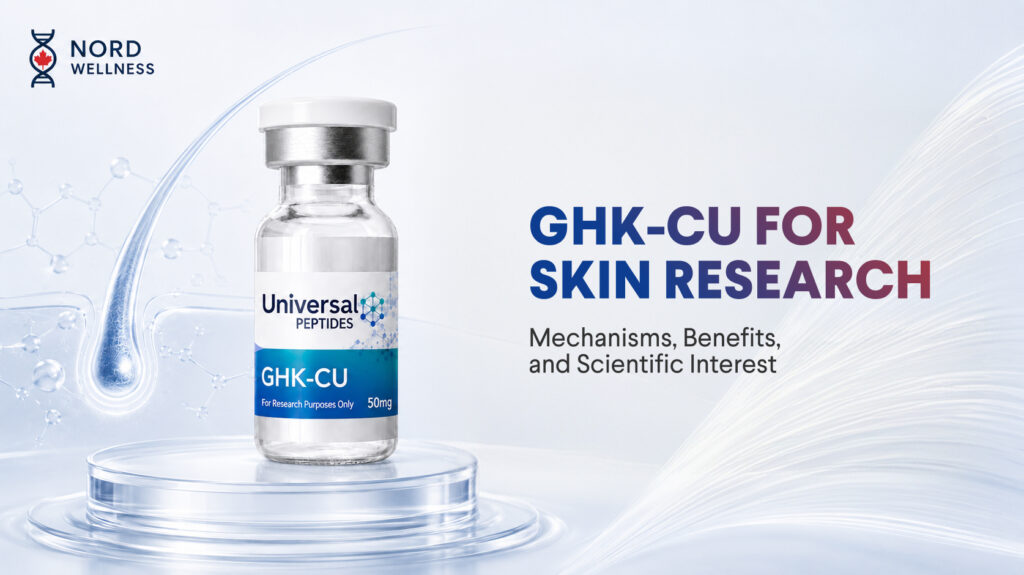
Aug
GHK-CU is a naturally occurring copper-binding tripeptide composed of glycine, histidine, and lysine. Due to its interaction with copper-dependent biological processes, GHK-CU for skin research has become an important area of study involving cellular signaling, collagen pathways, fibroblast activity, extracellular matrix regulation, and tissue repair.
Researchers continue to investigate how these interconnected mechanisms may influence skin biology and regenerative processes. Although experimental findings provide valuable insights, further studies are needed to establish their clinical relevance. For more educational information about GHK-Cu and peptide science, explore the research-focused resources available at Nord Wellness.
Why Researchers Study GHK-CU for Skin Health
Skin is a complex biological tissue that depends on continuous communication between cells and the surrounding extracellular matrix.
Researchers study GHK-CU for skin research because studies link the peptide to several biological pathways involved in skin structure and tissue maintenance.
| Research Area | Scientific Interest |
|---|---|
| Collagen pathways | Understanding connective tissue structure |
| Fibroblast activity | Studying cells involved in matrix production |
| Extracellular matrix | Exploring tissue organization and remodeling |
| Tissue repair | Investigating cellular recovery mechanisms |
| Oxidative responses | Examining cellular protection pathways |
One of the main reasons for this scientific interest is GHK’s ability to bind copper. Copper acts as an essential trace element in numerous enzymatic and cellular processes, making the GHK-Cu complex relevant to several areas of skin biology.
Collagen and Extracellular Matrix Research
Collagen is a major structural protein that contributes to the organization and mechanical properties of skin tissue.
However, collagen does not function independently. Its production and maintenance depend on coordinated fibroblast activity, cellular signaling, enzyme function, and extracellular matrix remodeling.
Research into GHK-CU for skin research therefore examines its potential relationship with collagen-related pathways and the broader tissue environment rather than focusing only on collagen production.
Fibroblast Activity
Fibroblasts produce collagen, elastin, and other extracellular matrix components.
GHK-CU research investigates how these cells respond to copper-peptide signaling and how such interactions may influence connective tissue organization.
Understanding fibroblast activity is particularly important because skin maintenance requires a balance between matrix production, degradation, and remodeling.
Explore GHK-CU Peptide for research purposes at GHK-CU Peptide
Skin Repair Mechanisms
Skin repair involves a coordinated series of biological processes rather than one isolated cellular response.
Researchers investigate GHK-Cu because several pathways associated with the peptide overlap with mechanisms involved in tissue repair.
| Biological Process | Research Focus |
|---|---|
| Cellular signaling | Communication during repair processes |
| Fibroblast activity | Connective tissue production |
| Matrix remodeling | Structural tissue organization |
| Oxidative response | Cellular stress regulation |
| Vascular processes | Support for repairing tissue |
Together, these processes provide a framework for understanding why GHK-CU for skin research remains an active area of regenerative biology.
Tissue Remodeling Research
Cells continuously reorganize the extracellular matrix by removing damaged or older components and replacing them with new ones.
Researchers have investigated GHK-Cu for its potential role in this remodeling environment.Researchers focus particularly on how copper-peptide signaling may interact with pathways that maintain structural tissue components.
Therefore, tissue repair research involves more than simply measuring collagen. It also considers how cells coordinate the removal, replacement, and organization of extracellular matrix structures.
Antioxidant and Cellular Protection Research
Oxidative stress can affect proteins, cellular membranes, DNA, and signaling pathways when reactive molecules exceed the capacity of cellular defense systems.
GHK-CU is studied for its potential relationship with antioxidant defense and cellular stress responses. These mechanisms may help researchers better understand how cells respond to challenging tissue environments.
However, researchers should not automatically interpret antioxidant activity observed in experimental models as evidence of a therapeutic effect in humans.
Current Research Findings
Current scientific findings suggest that GHK-Cu interacts with several biological processes relevant to skin structure, tissue maintenance, and cellular repair.
Rather than acting through one mechanism, research indicates that the peptide may influence multiple interconnected pathways.
| Scientific Area | Current Research Focus |
|---|---|
| Skin biology | Collagen and extracellular matrix pathways |
| Cellular biology | Fibroblast activity and signaling |
| Tissue research | Repair and remodeling mechanisms |
| Oxidative biology | Cellular stress responses |
| Regenerative research | Tissue maintenance pathways |
These findings provide a biological basis for continued investigation of GHK-CU for skin research.
Copper Binding and Cellular Activity
Copper binding is central to understanding GHK-Cu.
GHK has an affinity for copper ions and forms the GHK-Cu complex when the two interact. This copper-binding property provides a biochemical foundation for studying how the peptide may participate in cellular and tissue-related pathways.
In particular, researchers investigate the relationship between GHK-Cu and cellular signaling, connective tissue processes, oxidative responses, and extracellular matrix regulation.
What Current Evidence Suggests
Experimental findings suggest that GHK-Cu may interact with several pathways involved in tissue maintenance.
Research has explored its relationship with fibroblast activity, collagen-related processes, extracellular matrix remodeling, gene expression, oxidative stress, and cellular repair.
Importantly, these findings come from different types of experimental models. Therefore, the strength of evidence varies depending on the biological process and study design being examined.
GHK-CU Skin Research in Canada
Canadian readers should distinguish scientific findings from regulatory authorization and therapeutic claims.
Health Canada distinguishes cosmetic products from products represented as having therapeutic effects. Consequently, evidence that a peptide interacts with biological pathways does not mean Health Canada has authorized a specific commercial product to prevent, diagnose, or treat a medical condition.
This distinction is particularly important when evaluating GHK-CU for skin research. Researchers and consumers should treat laboratory findings, cosmetic applications, and authorized therapeutic uses as separate areas.
Explore GHK-CU Peptide for research purposes at GHK-CU Peptide
Research Limitations
Although GHK-Cu has been investigated across several areas of skin and regenerative biology, important limitations remain.
Much of the available mechanistic evidence comes from laboratory experiments, cell-based models, tissue research, and preclinical studies.
| Limitation | Explanation |
|---|---|
| Limited human evidence | More controlled clinical research is needed |
| Different study models | Results may vary between experimental systems |
| Complex mechanisms | Multiple biological pathways may interact |
| Formulation differences | Concentration and delivery may affect outcomes |
| Long-term effects | Further investigation remains necessary |
Therefore, experimental evidence showing biological activity should not automatically be interpreted as proof of a specific clinical outcome.
These limitations are particularly important when discussing potential GHK-CU skin benefits, as mechanistic findings and demonstrated therapeutic effects represent different levels of scientific evidence.
For a deeper understanding of GHK-Cu benefits, mechanisms, skin research, and scientific applications, read: GHK-Cu Peptide: Benefits, Mechanism, Skin Research, and Scientific Applications
FAQ About GHK-CU for Skin Research
What is GHK-CU for skin research?
GHK-CU for skin research focuses on studying how the copper-binding peptide GHK-Cu interacts with biological processes involving skin structure, fibroblast activity, collagen pathways, extracellular matrix remodeling, and tissue repair.
Why is GHK-Cu studied for skin?
Researchers study GHK-Cu because several of its proposed biological mechanisms relate to skin structure and tissue maintenance. These include copper binding, cellular signaling, fibroblast activity, and extracellular matrix regulation.
How does GHK-Cu interact with collagen?
GHK-Cu research examines its relationship with fibroblast activity and collagen-related extracellular matrix processes. However, researchers investigate collagen as only one component of GHK-Cu’s broader biological mechanisms.
What role does copper play in GHK-Cu?
Copper plays an essential role in numerous cellular and enzymatic processes. GHK binds copper to form the GHK-Cu complex, providing an important biochemical foundation for research into its biological activity.
Does GHK-Cu support skin repair?
Experimental research has investigated GHK-Cu in relation to cellular signaling, fibroblast activity, extracellular matrix remodeling, and other processes associated with tissue repair. However, researchers should not automatically interpret these findings as evidence of a specific clinical effect.
Is GHK-Cu proven to improve skin?
Current research provides mechanistic and experimental evidence related to several aspects of skin biology. Nevertheless, researchers need further controlled human studies to better establish the clinical relevance of these findings.
Is GHK-Cu approved for medical use in Canada?
Research evidence and regulatory authorization are separate considerations. In Canada, the regulatory status of a specific product depends on factors such as its formulation, intended use, claims, and authorization status.
Final Thoughts
GHK-CU for skin research remains scientifically interesting because the copper-peptide complex interacts with several pathways related to collagen regulation, fibroblast activity, extracellular matrix remodeling, oxidative responses, and tissue repair. Together, these mechanisms provide a foundation for continued research into GHK-Cu and skin biology.
However, much of the current evidence remains experimental, and additional controlled human research is needed to clarify clinical relevance. For a broader look at GHK-Cu mechanisms, benefits, skin research, and scientific applications, explore the educational resources available at Nord Wellness.
Disclaimer
This content is provided by Nord Wellness for educational and research purposes only. GHK-CU Peptide is not approved for the diagnosis, treatment, cure, or prevention of any disease.


This was a helpful read for anyone interested in the research surrounding copper peptides and skin health. The explanation makes it easier to understand why GHK-Cu continues to attract attention in skin-related research. I’d be curious to know which areas of this research currently have the most promising evidence.
Really enjoyed this overview of GHK-Cu and its role in skin research. I liked that the article focuses on the research behind its potential effects rather than simply presenting it as a skincare solution. It would be interesting to see more detail on how the findings from different studies compare.
Really enjoyed this article about GHK-Cu and its role in skin research. I liked how it explains the research behind the topic without making the potential effects sound guaranteed. It would be interesting to see more discussion about how findings from laboratory studies compare with human research.
Pingback: GHK-CU Peptide: Benefits, Mechanism, Skin Research, and Scientific Applications - nordwellness.is