
GHK-CU, Healing & Regeneration, Peptides
GHK-CU Research Applications: Skin, Hair, and Regenerative Research
Summarize the article with:
 ChatGPT
 Claude
 Perplexity
 Google AI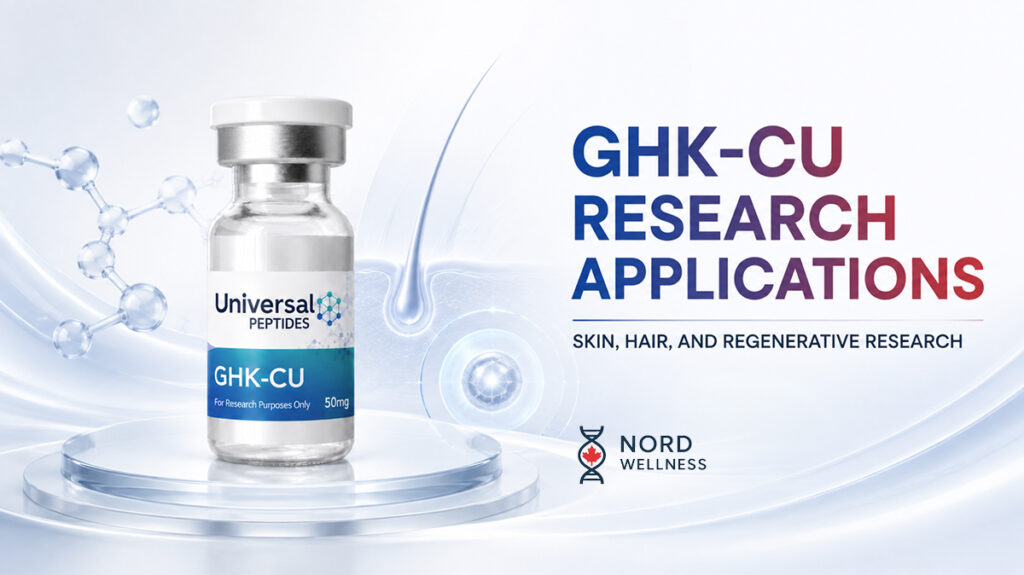
Aug
GHK-CU research applications include skin biology, hair follicle research, tissue remodeling, cellular signaling, and regenerative processes. GHK-Cu is a naturally occurring copper-binding tripeptide formed when glycyl-L-histidyl-L-lysine binds copper ions, giving researchers a basis for studying its role across multiple biological systems.
Researchers have investigated GHK-Cu across skin biology, tissue repair, hair follicle research, and regenerative processes. However, the strength of evidence differs between these areas, and experimental findings should not automatically be interpreted as established clinical benefits. For more educational information about GHK-Cu and peptide science, explore Nord Wellness.
Overview of GHK-CU Research
GHK-CU forms when GHK binds copper ions. This copper-binding property provides the biochemical basis for many GHK-CU research applications.
In particular, researchers investigate GHK-Cu in relation to skin biology, hair follicle signaling, extracellular matrix remodeling, tissue repair, and cellular communication.
| Research Area | Scientific Interest |
|---|---|
| Skin biology | Fibroblast and collagen pathways |
| Hair research | Follicular signaling |
| Tissue remodeling | Extracellular matrix organization |
| Regenerative biology | Cellular repair processes |
Rather than acting through one isolated pathway, GHK-Cu appears to interact with several interconnected biological mechanisms.
Explore GHK-CU Peptide for research purposes at GHK-CU Peptide
Dermatology Research
Notably, skin biology is one of the most established areas of GHK-Cu investigation.
Therefore, researchers study GHK-Cu in relation to fibroblast activity, collagen pathways, extracellular matrix remodeling, and tissue repair.
Fibroblast and Collagen Research
For example, fibroblasts produce collagen, elastin, and other extracellular matrix components. Therefore, scientists investigate whether GHK-Cu-related signaling may influence fibroblast activity and connective tissue organization.
Importantly, this research examines not only collagen production but also its organization, breakdown, and replacement within the extracellular matrix.
Extracellular Matrix Remodeling
The extracellular matrix provides structural support around cells and helps maintain skin organization.
Because this matrix constantly changes, researchers examine whether GHK-Cu may interact with pathways involved in removing damaged components and producing new structural material.
These mechanisms make dermatology one of the most important GHK-CU research applications.
Hair Growth Research
Meanwhile, hair follicle biology represents another developing area of GHK-Cu research.
Within the follicular environment, complex interactions occur between cells, signaling molecules, connective tissue, and extracellular matrix components. Therefore, researchers examine whether GHK-Cu-related mechanisms may influence the environment surrounding hair follicles.
Follicular Signaling and Tissue Environment
Current research focuses on follicular cellular activity, local signaling, extracellular matrix organization, and tissue remodeling.
A biologically plausible mechanism does not necessarily translate into visible hair regrowth. Therefore, researchers should distinguish hair follicle research from demonstrated hair-growth outcomes.
However, direct controlled human evidence remains limited, and further studies are needed.
Regenerative and Tissue Repair Research
Similarly, tissue repair is another important area within GHK-CU research applications.
Normal repair requires coordinated cellular signaling, fibroblast activity, extracellular matrix production, and tissue remodeling.
| Process | Research Focus |
|---|---|
| Cellular signaling | Communication during repair |
| Fibroblast activity | Connective tissue organization |
| Matrix remodeling | Structural tissue maintenance |
| Tissue repair | Coordinated regenerative processes |
These mechanisms provide a scientific rationale for continued investigation. However, laboratory findings cannot automatically establish regenerative effects in humans.
Emerging Applications
Furthermore, researchers continue to explore additional GHK-Cu mechanisms involving gene expression, cellular signaling, oxidative responses, and tissue maintenance.
These areas may broaden the understanding of GHK-Cu biology, but many remain exploratory. More research is needed to determine which mechanisms translate into meaningful biological outcomes.
Explore GHK-CU Peptide for research purposes at GHK-CU Peptide
Research Limitations
Nevertheless, several limitations remain despite decades of GHK-Cu research.
Experimental models vary in concentration, formulation, delivery method, and measured outcomes. In addition, findings from cell or preclinical studies may not translate directly into human effects.
Controlled human evidence also remains limited for several proposed GHK-CU research applications, especially hair growth and broader regenerative outcomes.
GHK-CU Research in Canada
Canadian readers should distinguish scientific research from regulatory authorization.
Evidence that GHK-CU interacts with biological pathways does not automatically mean that a specific product is authorized to diagnose, prevent, or treat a medical condition.
Therefore, scientific evidence, intended use, product quality, and regulatory status should be evaluated separately.
Future Research Directions
Looking ahead, future studies should focus on well-defined formulations, appropriate control groups, measurable biological endpoints, and controlled human research.
These studies may help determine which proposed GHK-Cu mechanisms translate into reproducible and clinically relevant outcomes.
For a deeper understanding of GHK-Cu benefits, mechanisms, skin research, and scientific applications, read: GHK-Cu Peptide: Benefits, Mechanism, Skin Research, and Scientific Applications
FAQ About GHK-CU Research Applications
What are the main GHK-CU research applications?
The main GHK-CU research applications include skin biology, hair follicle research, extracellular matrix remodeling, tissue repair, cellular signaling, and regenerative research.
Why is GHK-Cu studied in skin research?
Researchers study GHK-Cu because its proposed biological activity overlaps with fibroblast function, collagen pathways, extracellular matrix regulation, and tissue remodeling.
Is GHK-Cu studied for hair growth?
Yes. Researchers investigate GHK-Cu in relation to follicular signaling and the tissue environment surrounding hair follicles. However, direct human evidence remains limited.
What role does copper play in GHK-Cu?
GHK binds copper ions to form GHK-Cu. Copper participates in numerous cellular and enzymatic processes, making this interaction important for research.
Is GHK-Cu studied for tissue repair?
Yes. Researchers investigate GHK-Cu in experimental models involving cellular signaling, fibroblast activity, extracellular matrix remodeling, and tissue-repair processes.
Are GHK-CU research applications clinically proven?
Not all of them. Evidence varies between research areas, and many proposed applications still rely on mechanistic or preclinical findings.
Final Thoughts
GHK-CU research applications span skin biology, hair follicle research, extracellular matrix remodeling, tissue repair, and regenerative science. As a result, its copper-binding properties and interactions with several biological pathways continue to make GHK-Cu an important subject of research.
However, researchers still need stronger controlled human evidence to establish the clinical relevance of many proposed applications. For more educational information about GHK-Cu and peptide science, explore Nord Wellness.
Disclaimer
This content is provided by Nord Wellness for educational and research purposes only. GHK-CU Peptide is not approved for the diagnosis, treatment, cure, or prevention of any disease.


Really enjoyed this overview of the research applications being explored for GHK-Cu. I liked that the article focuses on specific areas of research rather than making broad claims about the peptide. It would be interesting to see which of these applications currently have the most substantial evidence behind them.
I appreciate the research-focused approach here, especially the distinction between areas being investigated and benefits that are already well established. There’s a lot of information about GHK-Cu online, so putting its potential applications into a research context is useful. More discussion about the current limitations of each research area would make a great follow-up.
This was a helpful introduction to the broader research surrounding GHK-Cu. I especially liked the focus on specific research areas rather than making broad claims about what the peptide can do. More detail about the limitations and unanswered questions in each area would make an interesting follow-up.