

CJC-1295, Growth Hormone Inducing Peptides, Peptides
CJC-1295 Peptide: Growth Hormone Research, Mechanism, Benefits, and Applications
Summarize the article with:
 ChatGPT
 Claude
 Perplexity
 Google AI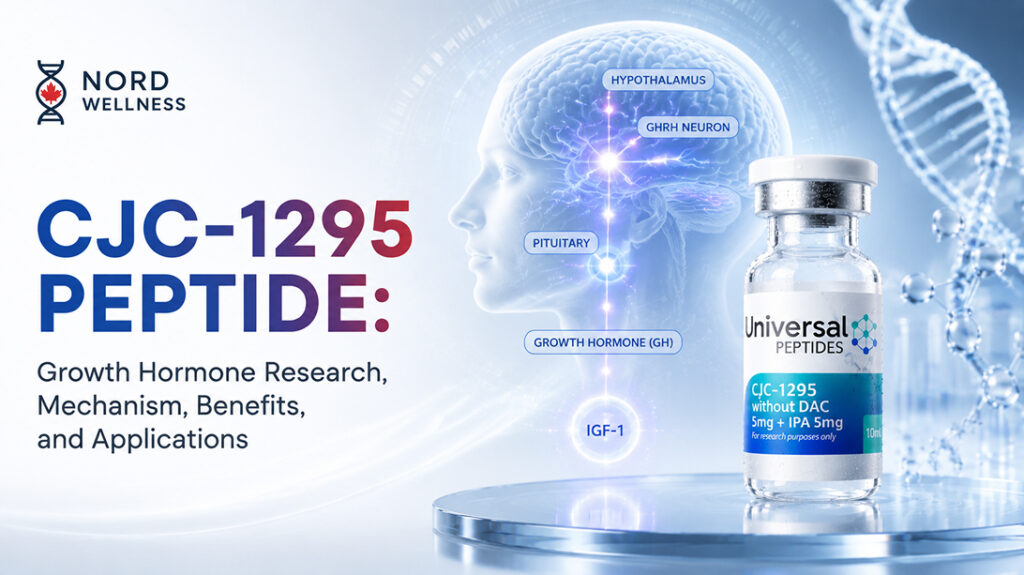
Jul
CJC-1295 Peptide is a synthetic analog of growth hormone-releasing hormone (GHRH) that has become widely studied in endocrine and metabolic research. It is primarily known for its ability to stimulate growth hormone (GH) secretion in a sustained manner, making researchers use it as a tool to understand GH pulsatility, insulin-like growth factor-1 (IGF-1) regulation, and broader endocrine signaling pathways.
In research settings, CJC-1295 is often used to explore how prolonged GH stimulation affects metabolism, tissue regeneration processes, and hormonal feedback loops within the hypothalamic–pituitary axis.
This article provides a detailed overview of its mechanism, biological role, research applications, and how it compares to other growth hormone-related peptides.
What Is CJC-1295 Peptide?
CJC-1295 is a synthetic peptide analogue of growth hormone-releasing hormone (GHRH 1–29). Researchers design it to mimic the natural activity of GHRH but with significantly enhanced stability and a longer half-life in circulation.
One of its key structural modifications is the Drug Affinity Complex (DAC) version, which allows it to bind to albumin in the bloodstream. This binding significantly extends its biological activity, enabling more sustained stimulation of the pituitary gland.
In research contexts, CJC-1295 is used to study:
- Growth hormone secretion patterns
- IGF-1 production in the liver
- Hormonal feedback regulation
- Endocrine system responsiveness
Importantly, CJC-1295 does not directly act as growth hormone. Instead, it functions upstream by stimulating the body’s own GH release pathways.
? Explore CJC-1295 Peptide for research purposes at CJC-1295 Peptide

How CJC-1295 Peptide Works
CJC-1295 works by binding to growth hormone-releasing hormone (GHRH) receptors and mimicking the natural activity of GHRH, but with significantly enhanced stability and a longer half-life in circulation.
The mechanism can be summarized as follows:
- Receptor binding: CJC-1295 binds to GHRH receptors on pituitary somatotroph cells.
- Signal activation: This activates cyclic AMP (cAMP) and protein kinase A (PKA) pathways.
- Growth hormone release: GH is secreted in pulses into systemic circulation.
- Downstream IGF-1 production: GH stimulates the liver to produce IGF-1, a key mediator of growth and metabolic effects.
Because of its extended half-life (especially in DAC form), CJC-1295 promotes a more sustained elevation of GH levels, rather than short spikes typical of natural GHRH secretion.
CJC-1295 and Growth Hormone Signaling
Growth hormone signaling is part of the hypothalamic–pituitary–somatotropic axis, a tightly regulated endocrine system. CJC-1295 influences this system by enhancing endogenous GH secretion without replacing or bypassing natural feedback loops.
Once GH is released, it binds to receptors in various tissues and triggers multiple downstream effects, including:
- Activation of IGF-1 production in the liver
- Regulation of glucose and lipid metabolism
- Modulation of protein synthesis pathways
- Support of tissue repair and cellular turnover processes
A key feature of CJC-1295 is that it helps maintain physiological pulsatility of GH secretion, which researchers consider important for normal endocrine function, unlike continuous exogenous hormone exposure.
Potential Benefits of CJC-1295 Research
In research environments, CJC-1295 is studied for several potential biological effects related to growth hormone modulation:
1. Growth Hormone Regulation
CJC-1295 helps researchers understand how sustained GH elevation influences endocrine feedback mechanisms and pituitary responsiveness.
2. IGF-1 Signaling Studies
By increasing GH levels, it indirectly raises IGF-1, allowing study of growth factor signaling in metabolic and cellular systems.
3. Metabolic Research
Growth hormone plays a role in fat metabolism, glucose regulation, and energy balance. CJC-1295 is used to explore these metabolic pathways in controlled studies.
4. Tissue and Cellular Research
IGF-1 participates in cellular repair and protein synthesis pathways, which leads researchers to consider CJC-1295 relevant in tissue regeneration models.
5. Endocrine Feedback Studies
Researchers use CJC-1295 to study how the hypothalamus and pituitary adjust hormone output in response to prolonged stimulation.
? Explore CJC-1295 Peptide for research purposes at CJC-1295 Peptide
Common Research Applications of CJC-1295
CJC-1295 is widely used in experimental endocrinology and physiology studies, including:
- Growth hormone pulsatility modeling
- Somatotropic axis regulation research
- IGF-1 pathway activation studies
- Metabolic and energy balance experiments
- Endocrine aging research models
- Pituitary responsiveness assessments
Because of its long-acting profile, it is particularly useful for studying chronic hormone stimulation effects rather than short-term endocrine responses.

CJC-1295 vs Other Growth Hormone Peptides
CJC-1295 is often compared with other GH-related peptides such as GHRP-6, Ipamorelin, and Sermorelin.
- CJC-1295 vs Sermorelin:
Sermorelin has a shorter half-life and mimics natural GHRH more closely, while CJC-1295 provides extended GH stimulation. - CJC-1295 vs GHRP peptides:
GHRP peptides stimulate GH via ghrelin receptors, whereas CJC-1295 works through GHRH receptors. They act on different pathways but can be complementary in research. - CJC-1295 vs endogenous GHRH:
CJC-1295 is more stable and longer-acting, allowing sustained receptor activation compared to natural GHRH, which has a very short half-life.
These differences make CJC-1295 particularly valuable for studying long-term endocrine modulation.
FAQ About CJC-1295 Peptide
What is CJC-1295 peptide?
CJC-1295 is a synthetic analog of growth hormone-releasing hormone that stimulates the body’s natural production of growth hormone.
How does CJC-1295 work?
It binds to GHRH receptors in the pituitary gland, activating signaling pathways that increase growth hormone secretion and downstream IGF-1 production.
Is CJC-1295 a growth hormone?
No. It is a peptide that stimulates the release of the body’s own growth hormone rather than replacing it.
Why is CJC-1295 used in research?
Researchers use it to study growth hormone regulation, metabolic pathways, IGF-1 signaling, and endocrine feedback systems.
How is CJC-1295 different from other peptides?
Its long half-life and sustained GH release make it distinct from short-acting GHRH analogs and ghrelin-mimetic peptides.
Final Thoughts
CJC-1295 Peptide plays a significant role in growth hormone research due to its ability to enhance and prolong endogenous GH secretion. Its mechanism of action provides valuable insight into endocrine regulation, metabolic control, and IGF-1 signaling pathways.
As research continues, CJC-1295 remains an important tool for studying the complexities of the somatotropic axis and its impact on physiology and metabolic function.
For more detailed peptide research insights, explore additional articles on Nordwellness.ca.
Disclaimer
This content is provided by Nord Wellness for educational and research purposes only. CJC-1295 Peptide is not approved for the diagnosis, treatment, cure, or prevention of any disease.



This was a great introduction to CJC-1295 and its role in growth hormone research. I appreciated how the article explained the peptide’s interaction with GHRH receptors and the downstream signaling process instead of focusing only on potential applications. The science-focused approach made the content both informative and easy to follow.
Really informative article overall. Many peptide resources briefly mention CJC-1295, but this article provided much more detail about growth hormone regulation, receptor signaling, and current research interest. I’d love to see a comparison between CJC-1295 and other GHRH analogs in future articles.
I really enjoyed reading this article. The explanation of growth hormone signaling, endocrine regulation, and peptide research applications was detailed enough to be educational while remaining accessible to readers who are still learning about peptide science. It’s refreshing to find content that stays balanced and research-focused throughout.
Pingback: How CJC-1295 Peptide Works: Growth Hormone Signaling, Mechanisms, and Research Insights - nordwellness.is
Pingback: How CJC-1295 Peptide Works: Growth Hormone Signaling, Mechanisms, and Research Insights - nordwellness.is
Pingback: CJC-1295 Peptide Mechanism: Understanding Its Role in Growth Hormone Research - nordwellness.is
Pingback: CJC-1295 Peptide Mechanism: Understanding Its Role in Growth Hormone Research - nordwellness.is
Pingback: CJC-1295 vs Ipamorelin: Differences, Mechanisms, Benefits, and Research Uses - nordwellness.is
Pingback: CJC-1295 vs Ipamorelin: Differences, Mechanisms, Benefits, and Research Uses - nordwellness.is
Pingback: CJC-1295 Peptide for Growth Hormone Research: Mechanisms, Benefits, and Scientific Interest - nordwellness.is
Pingback: CJC-1295 Peptide for Growth Hormone Research: Mechanisms, Benefits, and Scientific Interest - nordwellness.is