

CJC-1295, Growth Hormone Inducing Peptides, Peptides
CJC-1295 vs Ipamorelin: Differences, Mechanisms, Benefits, and Research Uses
Summarize the article with:
 ChatGPT
 Claude
 Perplexity
 Google AI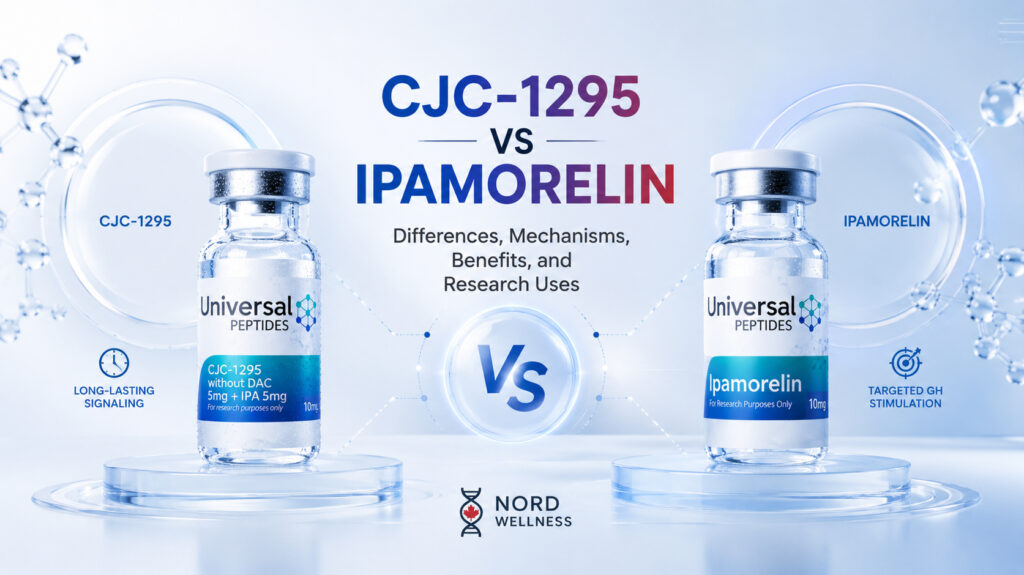
Jul
CJC-1295 and Ipamorelin are two widely studied peptides in growth hormone research, both involved in stimulating the growth hormone (GH) axis but through different biological pathways. Researchers often compare them to better understand how the hypothalamic–pituitary–somatotropic system regulates GH secretion, IGF-1 production, and metabolic signaling.
While both compounds influence GH release, their mechanisms, receptor targets, and duration of action differ significantly, making them valuable for different types of endocrine research models.
What Are CJC-1295 and Ipamorelin?
CJC-1295 is a synthetic analog of growth hormone-releasing hormone (GHRH). It acts by stimulating the pituitary gland to increase endogenous GH secretion. Its long-acting DAC version binds to albumin, extending its half-life and allowing sustained hormonal activity.
Ipamorelin is a selective growth hormone secretagogue peptide (GHS) that mimics the action of ghrelin. It stimulates GH release by binding to the ghrelin receptor (GHS-R1a) in the pituitary and hypothalamus.
Although both peptides increase GH levels, they do so via completely different receptor systems, making them important tools for comparative endocrine research.
? Explore CJC-1295 Peptide for research purposes at CJC-1295 Peptide
Comparing Their Mechanisms of Action
CJC-1295 Mechanism
CJC-1295 works through the GHRH receptor pathway:
- Binds to GHRH receptors on pituitary somatotroph cells
- Activates cAMP–PKA signaling pathways
- Stimulates pulsatile growth hormone release
- Increases downstream IGF-1 production in the liver
Its DAC version prolongs this effect by binding to albumin, extending its biological activity.

Ipamorelin Mechanism
Ipamorelin works through the ghrelin receptor pathway (GHS-R1a):
- Activates ghrelin receptors in the pituitary and hypothalamus
- Triggers GH release via calcium-dependent signaling
- Stimulates short, controlled pulses of GH secretion
- Does not significantly affect cortisol or prolactin in research models
Growth Hormone Research Applications
Both peptides are widely used in endocrine and metabolic research, particularly in studies involving:
- Growth hormone pulsatility and secretion dynamics
- IGF-1 signaling pathways and metabolic regulation
- Hypothalamic–pituitary axis feedback mechanisms
- Endocrine aging and hormonal decline models
- Energy metabolism and substrate utilization
CJC-1295 is often used in long-duration stimulation models, while Ipamorelin is used for short, precise GH pulse studies. This distinction allows researchers to analyze both acute and chronic endocrine responses.
? Explore CJC-1295 Peptide for research purposes at CJC-1295 Peptide
Key Differences Between CJC-1295 and Ipamorelin
1. Receptor Target
- CJC-1295: GHRH receptor
- Ipamorelin: Ghrelin receptor (GHS-R1a)
2. Mechanism Type
- CJC-1295: Mimics growth hormone-releasing hormone
- Ipamorelin: Mimics ghrelin (growth hormone secretagogue)
3. Duration of Action
- CJC-1295: Long-acting (especially DAC version)
- Ipamorelin: Short-acting, rapid pulse induction
4. GH Release Pattern
- CJC-1295: Sustained, amplified pulsatility
- Ipamorelin: Sharp, transient GH spikes
5. Endocrine Selectivity
- CJC-1295: Broad pituitary stimulation via GHRH pathway
- Ipamorelin: More selective GH release with minimal effect on other hormones
These differences make each peptide suitable for different experimental designs depending on the desired hormonal response profile.
Can CJC-1295 and Ipamorelin Be Studied Together?
In research settings, CJC-1295 and Ipamorelin are sometimes studied in combination to evaluate synergistic effects on growth hormone secretion.
Because they act on different receptors, their pathways do not directly compete. Instead, they may:
- Enhance overall GH pulse amplitude
- Improve secretion consistency over time
- Provide a more complete model of GH axis activation
- Allow detailed study of dual-pathway endocrine regulation
This dual approach is useful in studying how multiple signaling systems converge to regulate the somatotropic axis. However, outcomes depend on experimental design, dosing structure, and biological model used.
For a deeper understanding of CJC-1295, including its mechanism, growth hormone research, benefits, and scientific applications, read the full article: CJC-1295 Peptide: Growth Hormone Research, Mechanism, Benefits, and Applications.
FAQ About CJC-1295 vs Ipamorelin
What is the main difference between CJC-1295 and Ipamorelin?
CJC-1295 activates GHRH receptors, while Ipamorelin activates ghrelin receptors. Both increase growth hormone but through different pathways.
Which peptide has a longer duration?
CJC-1295, especially in DAC form, has a significantly longer half-life compared to Ipamorelin.
Do they produce the same type of growth hormone release?
No. CJC-1295 produces sustained GH pulsatility, while Ipamorelin induces shorter, sharper GH pulses.
Can they be studied together in research?
Yes. They are sometimes studied together to evaluate combined effects on GH secretion through different receptor systems.
Why are both peptides important in research?
They help researchers understand how different hormonal pathways regulate GH release and endocrine system balance.
Final Thoughts
CJC-1295 and Ipamorelin are two important peptides in growth hormone research, each operating through distinct biological pathways. CJC-1295 provides sustained stimulation via GHRH receptors, while Ipamorelin induces rapid GH release through ghrelin receptor activation.
Together, they offer complementary insights into endocrine regulation, making them valuable tools for studying growth hormone dynamics, metabolic processes, and pituitary function.
Disclaimer
This content is provided by Nord Wellness for educational and research purposes only. CJC-1295 Peptide is not approved for the diagnosis, treatment, cure, or prevention of any disease.



This was one of the clearest comparisons between CJC-1295 and Ipamorelin that I’ve read. I appreciated how the article explained that the two peptides work through different receptor pathways while complementing each other in growth hormone research. The science-focused approach made the comparison much more useful than a simple feature list.
Great article overall. Many comparisons focus only on potential applications, but this one did a great job explaining the differences in GHRH signaling versus ghrelin receptor activation. I especially liked how the article highlighted why researchers often discuss these peptides together while still recognizing their distinct mechanisms.
Really enjoyed reading this comparison. The explanation of receptor interactions, endocrine signaling, and the complementary roles of CJC-1295 and Ipamorelin was detailed enough to be educational while remaining easy to follow. I’d love to see more side-by-side comparisons covering other growth hormone–related peptides in future articles.