

Growth Hormone Inducing Peptides, Kisspeptin-10, Peptides
Kisspeptin-10 and Hormone Signaling: Understanding Its Role in Endocrine Function
Summarize the article with:
 ChatGPT
 Claude
 Perplexity
 Google AI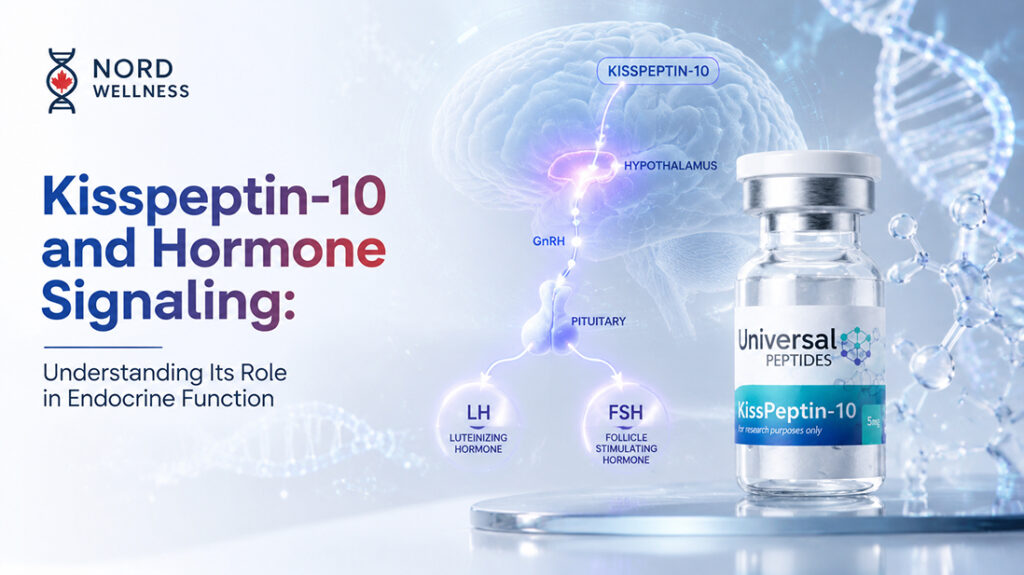
Jun
Kisspeptin-10 is a key peptide in the regulation of reproductive hormones and has emerged as a central molecule in endocrine research. Its ability to modulate the hypothalamic–pituitary–gonadal (HPG) axis positions it as a critical regulator of reproductive function, puberty, and fertility. Understanding Kisspeptin-10’s role in hormone signaling provides insight into how the endocrine system integrates signals from the brain, metabolism, and environment to maintain physiological balance.
This article explores the role of Kisspeptin-10 in hormone signaling, its impact on GnRH regulation, and current research findings, while highlighting future research opportunities.
What Is Hormone Signaling?
Hormone signaling is the process by which chemical messengers, known as hormones, are released by glands into the bloodstream or local tissue and communicate with target cells to regulate physiological functions. In particular, hormones influence growth, metabolism, reproduction, stress response, and numerous other biological processes.
Effective hormone signaling depends on:
- Precise receptor binding: Target cells must express specific receptors to detect hormonal signals.
- Intracellular signal transduction: Hormone-receptor interaction triggers signaling cascades inside cells.
- Feedback regulation: Hormone levels are often modulated by negative or positive feedback to maintain balance.
Disruptions in hormone signaling can lead to reproductive disorders, metabolic dysfunctions, or other endocrine-related conditions. Consequently, peptides like Kisspeptin-10 play a crucial role in initiating and modulating these signals.
? Explore Kisspeptin-10 Peptide for research purposes at Kisspeptin-10 Peptide
The Role of Kisspeptin-10 in Hormonal Communication
Kisspeptin-10 functions as a neuropeptide signal that communicates directly with GnRH neurons in the hypothalamus. In particular, it binds to the KISS1 receptor (KISS1R/GPR54), triggering a cascade of intracellular events:
- Calcium mobilization: Activates neuronal firing and hormone release.
- Protein kinase signaling: Modulates gene expression and neuronal excitability.
- Neuronal depolarization: Initiates the pulsatile secretion of GnRH.
By acting upstream of GnRH, Kisspeptin-10 orchestrates the release of downstream reproductive hormones such as luteinizing hormone (LH) and follicle-stimulating hormone (FSH). This signaling allows the body to integrate reproductive cues with environmental and metabolic information.
In essence, Kisspeptin-10 serves as a gateway signal that ensures reproductive hormones are released in a regulated, pulsatile manner, which is critical for fertility and normal reproductive cycles.
Kisspeptin-10 and GnRH Regulation
GnRH neurons are the primary controllers of LH and FSH secretion. Specifically, Kisspeptin-10’s influence on GnRH occurs through:
- Direct receptor binding: Activates KISS1R on GnRH neurons.
- Signal transduction cascades: PLC and PKC pathways increase intracellular calcium, triggering neuronal activity.
- Pulsatile hormone release: Ensures rhythmic LH and FSH secretion, which is necessary for gametogenesis and sex steroid production.
Research indicates that Kisspeptin-10 is essential for initiating puberty, maintaining normal reproductive cycles, and responding to metabolic or environmental changes that affect fertility. Its role in GnRH regulation also highlights its potential relevance in treating reproductive disorders.
Research Findings on Hormone Signaling
Scientific studies on Kisspeptin-10 and hormone signaling have revealed several important insights:
- Puberty induction: Animal models show Kisspeptin-10 triggers GnRH release, initiating sexual maturation.
- Fertility modulation: Pulsatile administration of Kisspeptin-10 can stimulate LH and FSH release, suggesting potential applications in fertility treatments.
- Neuroendocrine integration: Kisspeptin-10 neurons respond to stress, energy balance, and leptin levels, linking metabolic status to reproductive hormone regulation.
- Sex steroid feedback: Kisspeptin-10 is sensitive to estrogen and testosterone, ensuring proper negative and positive feedback regulation within the HPG axis.
Despite these findings, limitations exist, including variability in human responses, short peptide half-life, and interactions with overlapping hormonal pathways. These factors underscore the need for ongoing research.
? Explore Kisspeptin-10 Peptide for research purposes at Kisspeptin-10 Peptide
Future Research Directions
Emerging research opportunities for Kisspeptin-10 include:
- Therapeutic applications: Exploring potential treatments for hypogonadism, infertility, and delayed puberty.
- Peptide analog development: Designing stable Kisspeptin-10 derivatives with improved bioavailability.
- Neurobehavioral studies: Investigating links between Kisspeptin-10, mood, circadian rhythms, and stress response.
- Systems biology approaches: Integrating Kisspeptin-10 signaling into models of endocrine network regulation.
- Combination studies: Exploring synergistic effects with other neuropeptides or hormonal regulators for improved reproductive outcomes.
These avenues suggest that Kisspeptin-10 research will continue to expand, and in doing so, it bridges basic science and translational applications.
For a more detailed overview of Kisspeptin-10, including its benefits and broader research applications, read: Kisspeptin-10 Peptide: Mechanism, Hormone Signaling, Benefits, and Research Applications.
FAQ About Kisspeptin-10 and Hormone Signaling
What is Kisspeptin-10?
Kisspeptin-10 is a decapeptide derived from the kisspeptin protein that acts as a signaling molecule to stimulate GnRH neurons and regulate reproductive hormones. In particular, it plays a central role in coordinating the release of LH and FSH in the hypothalamic-pituitary-gonadal axis.
How does Kisspeptin-10 affect hormone signaling?
It binds to KISS1R receptors on GnRH neurons, triggering intracellular pathways that lead to pulsatile GnRH release and downstream LH and FSH secretion. As a result, it plays a key role in regulating reproductive hormone signaling.
Is Kisspeptin-10 a hormone?
No. It is a signaling peptide that indirectly regulates hormone release rather than acting as a circulating hormone itself.
Can Kisspeptin-10 be used clinically?
Currently, its use is largely limited to research. Clinical applications, such as fertility treatments or hypogonadism therapy, are under investigation.
Does Kisspeptin-10 influence other physiological systems?
Yes. Kisspeptin-10 may integrate signals related to metabolism, stress, and circadian rhythms, linking these factors to reproductive hormone regulation.
Final Thoughts
Kisspeptin-10 plays a central role in endocrine function by regulating GnRH neurons and coordinating reproductive hormone signaling. Its upstream action ensures proper hormone pulsatility, fertility, and integration with metabolic and environmental cues.
Continued research on Kisspeptin-10 will deepen our understanding of reproductive endocrinology, open new therapeutic possibilities, and provide valuable insights into the complex interactions of the endocrine system.
Disclaimer
This content is provided by Nord Wellness for educational and research purposes only. Kisspeptin-10 Peptide is not approved for the diagnosis, treatment, cure, or prevention of any disease.



This was a very informative article on Kisspeptin-10 and hormone signaling. I appreciated how the article explained the relationship between KISS1R activation, GnRH release, and the broader endocrine signaling cascade in a way that was both detailed and easy to follow. The science-focused approach made the content much more valuable than a typical overview.
Great article overall. Many resources briefly mention hormone signaling, but this piece clearly explained how Kisspeptin-10 functions as an upstream regulator within the HPG axis. I especially liked the discussion connecting receptor signaling with reproductive hormone regulation and ongoing research interest.
Really enjoyed reading this article. The explanation of hormonal communication, receptor interactions, and downstream signaling pathways was detailed enough to be educational while remaining accessible to readers without a strong endocrinology background. I’d love to see more research-focused articles exploring how Kisspeptin-10 compares with other neuroendocrine peptides.