

Cognitive & Sleep Support, Peptides, Selank
Selank Peptide Mechanism: Understanding Its Effects on Brain Function and Neurochemical Activity
Summarize the article with:
 ChatGPT
 Claude
 Perplexity
 Google AI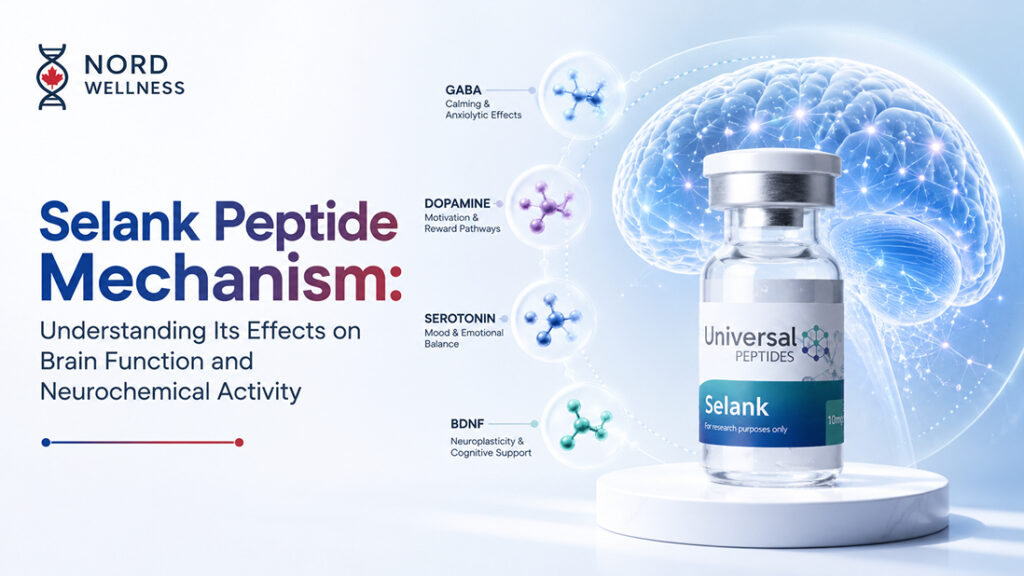
Jun
The study of neuroactive peptides has expanded significantly in recent decades as researchers seek to better understand the biological processes that regulate cognition, emotional resilience, stress adaptation, and neural communication. Among the compounds receiving increasing scientific attention is Selank peptide, a synthetic peptide derived from the naturally occurring immune peptide tuftsin.
Unlike many compounds that target a single receptor or signaling pathway, Selank appears to exert effects across multiple neurochemical systems. Researchers have investigated its influence on neurotransmitter regulation, stress-response pathways, immune signaling, and cognitive performance, making it one of the more extensively studied peptides in behavioral neuroscience.
Understanding the Selank peptide mechanism is important because it provides insight into how peptide-based compounds may influence brain function without relying on traditional pharmacological approaches. While many aspects of its activity remain under investigation, current evidence suggests that Selank acts as a broad neuromodulator capable of influencing several interconnected biological systems.
At Nord Wellness, we provide high-quality research peptides intended exclusively for laboratory and scientific investigation. This article explores what researchers currently know about the mechanisms underlying Selank’s biological activity.
What Is the Selank Peptide Mechanism?
The term “Selank peptide mechanism” refers to the collection of biological processes through which Selank influences neural and physiological function.
Selank is a synthetic heptapeptide developed from tuftsin, an endogenous peptide involved in immune regulation. Researchers modified tuftsin to improve its stability and biological activity while maintaining its ability to interact with important signaling pathways.
Unlike compounds that directly stimulate or block a specific receptor, Selank appears to function primarily through modulation of existing neural systems. This means it may help influence how neurotransmitter networks communicate rather than forcing a single pathway into activation.
Current research suggests that Selank may affect:
- GABAergic signaling
- Serotonergic pathways
- Dopaminergic activity
- Stress-response mechanisms
- Neuroimmune communication
- Gene expression related to neural function
The interaction of these systems likely contributes to the diverse observations reported across experimental studies.

How Selank Interacts With Neurotransmitter Systems
One of the most important aspects of the Selank peptide mechanism involves its influence on neurotransmitters.
Neurotransmitters serve as chemical messengers that allow neurons to communicate throughout the brain and nervous system. Alterations in neurotransmitter balance can significantly affect cognition, mood, memory, and behavior.
GABAergic Modulation
The neurotransmitter most commonly associated with Selank is gamma-aminobutyric acid (GABA).
GABA functions as the primary inhibitory neurotransmitter within the central nervous system and plays a crucial role in regulating:
- Neural excitability
- Stress responses
- Emotional processing
- Behavioral adaptation
Research suggests that Selank may enhance the efficiency of GABAergic signaling without directly acting as a traditional GABA receptor agonist.
This indirect modulation may allow the brain to maintain natural regulatory processes while supporting balanced neural activity.
Effects on Serotonin Pathways
Serotonin is involved in numerous physiological functions, including:
- Mood regulation
- Emotional resilience
- Cognitive flexibility
- Learning processes
Experimental studies have reported alterations in serotonin metabolism and receptor-related activity following Selank administration.
Researchers believe these interactions may contribute to the peptide’s observed influence on emotional and behavioral responses.
Influence on Dopamine Signaling
Dopamine plays a critical role in:
- Motivation
- Reward processing
- Attention
- Goal-directed behavior
Several investigations suggest Selank may influence dopaminergic pathways either directly or indirectly through broader neurotransmitter regulation.
This has generated interest in Selank as a model compound for studying motivation-related neurobiology.
Norepinephrine and Attention Networks
Norepinephrine contributes to:
- Alertness
- Focus
- Cognitive performance
- Adaptive stress responses
Research indicates Selank may affect pathways associated with norepinephrine signaling, potentially influencing cognitive processes during stressful conditions.
? Explore Selank Peptide for research purposes at Selank Peptide
Selank and Stress-Response Pathways
One reason Selank has attracted substantial research interest is its apparent influence on stress-related biological systems.
Stress activates multiple physiological pathways, including neural, endocrine, and immune responses. Chronic activation of these systems can affect cognition, emotional regulation, and overall neurological function.
Modulation of Stress Signaling
Researchers have observed that Selank may influence neural circuits involved in stress adaptation.
Potential mechanisms include:
- Improved neurotransmitter balance
- Stabilization of neural communication
- Enhanced adaptive responses to stressors
- Regulation of behavioral stress responses
Rather than suppressing stress responses entirely, Selank appears to support more efficient adaptation to environmental challenges.
Interaction With Neuroendocrine Systems
The brain’s stress-response network involves complex interactions between neurotransmitters and hormonal signaling systems.
Researchers continue investigating whether Selank influences pathways associated with:
- Cortisol regulation
- Hypothalamic signaling
- Neuroendocrine communication
- Stress-related gene expression
Although further research is needed, these areas represent important directions for future investigation.
Neuroimmune Contributions
The immune system and nervous system communicate extensively through signaling molecules and inflammatory mediators.
Because Selank is derived from an immune-regulating peptide, researchers have explored its effects on:
- Cytokine activity
- Immune signaling pathways
- Neuroinflammatory responses
- Brain-immune communication
This unique characteristic distinguishes Selank from many other cognitive research peptides.

Potential Cognitive Mechanisms of Selank
Researchers are particularly interested in how Selank may influence cognitive performance through its effects on neurotransmitter systems and neural communication.
Learning and Memory Processes
Several studies have investigated Selank’s role in:
- Memory acquisition
- Memory consolidation
- Information retention
- Learning efficiency
Researchers hypothesize that enhanced neurotransmitter balance may contribute to these observations.
Synaptic Communication
Neurons communicate through specialized structures known as synapses.
Experimental findings suggest Selank may influence:
- Synaptic signaling efficiency
- Neural network communication
- Information processing
- Adaptive neural responses
Improved communication between neurons may help explain some of the cognitive outcomes reported in research settings.
Neuroplasticity-Related Activity
Neuroplasticity refers to the brain’s ability to modify and reorganize neural connections.
Although the precise mechanisms remain under investigation, Selank may influence biological processes associated with:
- Neural adaptation
- Functional connectivity
- Learning-related changes
- Long-term neural regulation
These effects remain an active area of neuroscience research.
Gene Expression and Neural Function
Emerging evidence suggests Selank may alter the expression of genes involved in:
- Neurotransmitter synthesis
- Receptor regulation
- Cellular signaling
- Neural adaptation
Changes in gene expression may help explain why some observed effects persist beyond immediate peptide exposure.
? Explore Selank Peptide for research purposes at Selank Peptide
Research Areas Involving Selank
Selank continues to be studied across several scientific disciplines.
Behavioral Neuroscience
Researchers investigate Selank in models involving:
- Stress adaptation
- Emotional regulation
- Anxiety-related behaviors
- Behavioral flexibility
Cognitive Research
Current studies examine potential effects on:
- Memory performance
- Attention
- Learning
- Executive function
Neurochemistry
Selank serves as a useful model for studying:
- Neurotransmitter interactions
- GABA regulation
- Serotonin signaling
- Dopamine pathways
Neuroimmunology
Growing evidence supporting neuroimmune interactions has increased interest in Selank as a research tool for:
- Cytokine regulation
- Neuroinflammation
- Brain-immune communication
- Cellular adaptation
Peptide-Based Neuroscience
Researchers continue evaluating Selank as part of a broader effort to understand how peptides may influence brain function and physiological regulation.
New to Selank research? Explore our complete guide: Selank Peptide: Benefits, Mechanism, Research Applications, and Scientific Insights.
FAQ About Selank Peptide Mechanism
What is the Selank peptide mechanism?
The Selank peptide mechanism refers to the biological pathways through which Selank influences neurotransmitter systems, stress responses, neuroimmune communication, and cognitive processes.
Does Selank directly activate GABA receptors?
Current evidence suggests Selank primarily modulates GABAergic signaling indirectly rather than functioning as a direct receptor agonist.
Which neurotransmitters are influenced by Selank?
Research suggests Selank may affect GABA, serotonin, dopamine, and norepinephrine-related pathways.
Why do researchers study Selank?
Researchers investigate Selank because of its potential influence on stress adaptation, cognition, neurotransmitter regulation, and neuroimmune signaling.
Does Selank affect brain function?
Experimental findings indicate that Selank may influence neural communication, cognitive performance, emotional regulation, and adaptive stress responses.
Is the complete mechanism of Selank fully understood?
No. While significant progress has been made, researchers continue studying the precise molecular and cellular mechanisms underlying Selank’s effects.
Final Thoughts
The Selank peptide mechanism represents a fascinating example of how synthetic peptides may influence multiple biological systems simultaneously. Rather than acting through a single target, Selank appears to modulate neurotransmitter activity, stress-response pathways, neural communication networks, and neuroimmune interactions.
Its broad biological profile has made it an important subject of research in neuroscience, cognitive science, and neuroimmunology. Although many mechanistic questions remain unanswered, current evidence suggests Selank provides valuable insight into how peptide-based compounds may affect brain function and physiological adaptation.
As research continues, Selank will likely remain a significant tool for scientists exploring the complex relationship between neurotransmitters, cognition, stress, and neural resilience.
For researchers interested in high-quality laboratory peptides, explore the research collection available at Nord Wellness
Disclaimer
This content is provided by Nord Wellness for educational and research purposes only. Selank Peptide is not approved for the diagnosis, treatment, cure, or prevention of any disease.



This was a very informative explanation of Selank’s mechanism of action. I appreciated how the article broke down neurotransmitter regulation, cellular signaling, and neuropeptide activity into a format that was easy to understand while still remaining scientifically detailed. The discussion around GABA-related pathways was especially interesting and added valuable context to the topic.
Great article overall. Many resources mention Selank’s potential effects, but this piece did a much better job explaining the underlying biological mechanisms and how different signaling systems may interact. I especially liked the focus on neurotransmitter modulation and the broader research interest surrounding this peptide.
Really enjoyed reading this article. The explanation of GABAergic activity, neurochemical balance, and immune-related signaling made a complex topic much easier to follow. It’s refreshing to find research-focused content that presents peptide science in a clear, balanced, and educational way.
Pingback: Selank Peptide: Benefits, Mechanism, Research Applications, and Scientific Insights - nordwellness.is