

AOD 9604, Peptides, Weight Management & Metabolic Health
AOD-9604 vs HGH Fragment: Key Differences, Mechanisms, and Research Applications
Summarize the article with:
 ChatGPT
 Claude
 Perplexity
 Google AI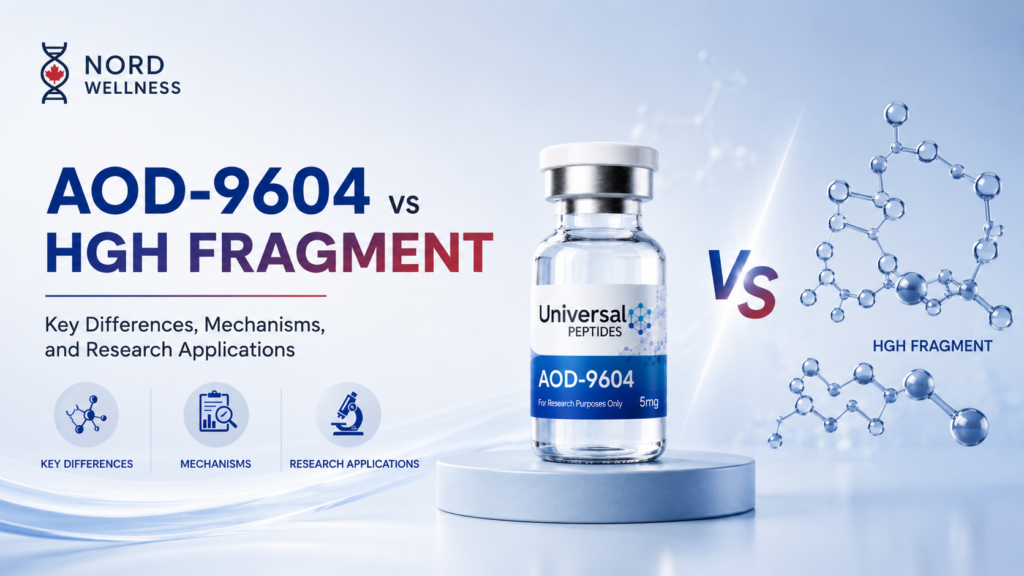
Jul
In peptide research, both AOD-9604 and full-length human growth hormone (HGH) fragments are of interest for their effects on metabolism, fat mobilization, and energy regulation. While they share a common origin in growth hormone signaling, their mechanisms, specificity, and research applications differ significantly. Understanding these differences is critical for researchers investigating fat metabolism, adipocyte function, and metabolic regulation.
This article explores the distinctions between AOD-9604 and HGH fragments, compares their mechanisms of action, and highlights their respective research applications.
What Are AOD-9604 and HGH Fragment?
AOD-9604 is a synthetic peptide derived from the C-terminal fragment of human growth hormone (amino acids 177–191). Researchers designed it to retain lipolytic (fat-reducing) properties while minimizing the broader systemic effects seen with full-length growth hormone.
HGH fragments, by contrast, refer to various naturally occurring or synthetic segments of human growth hormone that may retain some metabolic or growth-promoting effects but are less targeted in fat-specific activity. These fragments can influence IGF-1 levels, glucose metabolism, and systemic growth processes, depending on the segment used.
? Explore AOD-9604Peptide for research purposes at AOD-9604 Peptide
Comparing Their Mechanisms of Action
| Feature | AOD-9604 | HGH Fragment |
|---|---|---|
| Primary Target | Adipocytes (fat cells) | Broad systemic targets including liver, muscle, and fat |
| Lipolysis Effect | High specificity; promotes fat breakdown | Variable; may stimulate lipolysis indirectly via GH signaling |
| IGF-1 Influence | Minimal | Often increases IGF-1 depending on fragment |
| Glucose Impact | Minimal | Can affect glucose and insulin levels |
| Research Use | Fat metabolism, energy balance studies | Metabolism, growth, and endocrine studies |
AOD-9604 provides a focused lipolytic effect, while HGH fragments often have a broader endocrine influence, which may complicate interpretation in fat-specific studies.
Similarities Between AOD-9604 and HGH Fragment
Despite their differences, these peptides share certain characteristics:
- Origin: Both are derived from human growth hormone sequences.
- Peptide-based structure: Both are short amino acid sequences suitable for preclinical and in vitro studies.
- Mechanistic overlap: Both can influence metabolic pathways related to lipid mobilization and energy balance, though AOD-9604 is more targeted.
- Research utility: Both provide controlled tools to study metabolic regulation, though experimental goals differ.
Research Applications and Differences
AOD-9604 Applications:
- Fat-specific lipolysis studies in adipocytes
- Energy balance and fatty acid mobilization research
- Obesity and metabolic disorder preclinical models
- Cytoprotective studies related to lipid metabolism
HGH Fragment Applications:
- Studying systemic metabolic effects of partial GH sequences
- Investigating growth-related or anabolic signaling in various tissues
- Preclinical exploration of IGF-1-mediated pathways
- Endocrine function and metabolic regulation research
The key distinction lies in target specificity: researchers design AOD-9604 to focus on fat metabolism, whereas HGH fragments have broader effects and can influence multiple tissues.
? Explore AOD-9604 Peptide for research purposes at AOD-9604 Peptide
Which Peptide Is More Commonly Studied?
AOD-9604 is widely studied in fat metabolism and obesity-related research, whereas HGH fragments are more often investigated for general growth hormone effects, metabolic regulation, and endocrine signaling. The choice of peptide depends on the research objective: whether the study aims to isolate fat-specific lipolysis or explore systemic growth hormone pathways.
For a deeper exploration of AOD-9604 peptide, including its mechanism, fat metabolism research, and scientific applications, read the full article: AOD-9604 Peptide: Mechanism, Fat Metabolism Research, and Scientific Applications
FAQ About AOD-9604 vs HGH Fragment
What is the main difference between AOD-9604 and HGH fragments?
AOD-9604 selectively targets adipocytes to promote lipolysis, whereas HGH fragments can have broader systemic effects, including IGF-1 modulation.
Can both peptides be used to study fat metabolism?
Yes, but AOD-9604 provides more precise fat-specific effects, while HGH fragments may influence metabolism indirectly through systemic GH pathways.
Are HGH fragments safer for research studies?
Safety depends on dosage and context; AOD-9604 generally offers targeted effects with minimal systemic interference, making it preferable for fat-focused studies.
Which peptide is more relevant for obesity research?
Researchers generally favor AOD-9604 because it selectively stimulates lipolysis while minimally impacting blood glucose or growth pathways.
Are there limitations to using AOD-9604 or HGH fragments in research?
Most data come from preclinical studies. Researchers note that human translational studies are limited, and systemic effects of HGH fragments can complicate interpretation of fat-specific results.
Final Thoughts
Both AOD-9604 and HGH fragments have valuable applications in peptide research. AOD-9604 is optimized for fat metabolism studies and energy regulation, whereas HGH fragments provide insight into broader growth hormone and endocrine functions. Selecting the right peptide depends on research goals, tissue specificity, and metabolic endpoints.
Disclaimer
This content is provided by Nord Wellness for educational and research purposes only. AOD-9604 Peptide is not approved for the diagnosis, treatment, cure, or prevention of any disease.



This was one of the clearest comparisons between AOD-9604 and the HGH Fragment that I’ve read. I appreciated how the article explained their structural relationship, key differences, and the rationale behind the modification without oversimplifying the science. The research-focused approach made it much easier to understand how these peptides are evaluated in metabolic research.
Great article overall. Many resources treat AOD-9604 and the HGH Fragment as if they were identical, but this article did a great job highlighting their distinctions and explaining why researchers consider those differences important. I especially liked the discussion about peptide stability, molecular design, and the current evidence surrounding each compound.
Really enjoyed reading this comparison. The explanation of peptide structure, metabolic signaling, and research applications was detailed enough to be educational while remaining easy to follow. I’d be interested in seeing a future article comparing AOD-9604, HGH Fragment 176–191, and other metabolism-focused peptides from a mechanistic perspective.
Pingback: AOD-9604 Peptide: Mechanism, Fat Metabolism Research, and Scientific Applications - nordwellness.is