

Immune & Specialized Peptides, SS-31
SS-31 Peptide: Mitochondrial Function, Mechanism, Research Applications, and Benefits
Summarize the article with:
 ChatGPT
 Claude
 Perplexity
 Google AI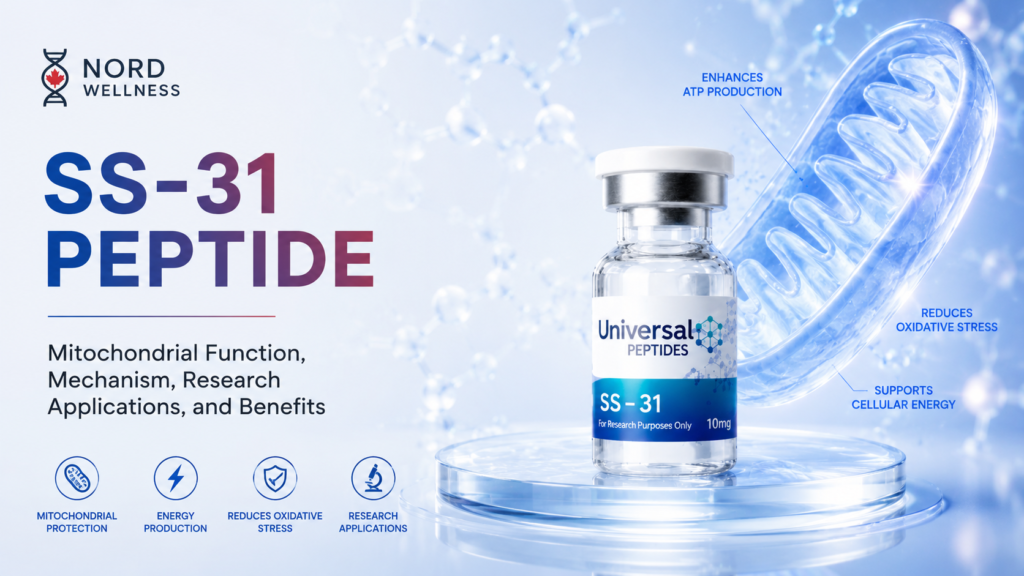
Jul
SS-31 Peptide, also known as Elamipretide, is a mitochondria-targeted tetrapeptide that has garnered attention in research due to its ability to improve mitochondrial efficiency and reduce oxidative stress. By selectively targeting mitochondrial membranes, SS-31 offers a unique approach to understanding cellular bioenergetics, mitochondrial dysfunction, and related disease processes.
In research contexts, SS-31 is not used as a therapeutic agent for humans but serves as a valuable tool to explore mitochondrial function, cellular metabolism, and cytoprotective mechanisms. This article provides an in-depth overview of SS-31’s mechanism of action, its role in mitochondria, potential benefits, and current research applications.
What Is SS-31 Peptide?
SS-31 is a small, synthetic peptide composed of four amino acids: D-Arg-DimethylTyr-Lys-Phe-NH2. Its design enables it to penetrate mitochondrial membranes and interact with cardiolipin, a lipid unique to the inner mitochondrial membrane.
Key features of SS-31 include:
- High mitochondrial selectivity
- Ability to reduce reactive oxygen species (ROS) production
- Preservation of mitochondrial membrane potential
- Enhancement of ATP production in energy-demanding cells
Due to these properties, SS-31 has become an important research compound for studying mitochondrial dynamics, oxidative stress, and energy metabolism.
? Explore SS-31 Peptide for research purposes at SS-31 Peptide

How SS-31 Peptide Works
SS-31 functions through mitochondrial targeting and cardiolipin interaction:
- Mitochondrial targeting: SS-31 crosses cell membranes and accumulates in mitochondria due to its lipophilic and cationic nature.
- Cardiolipin binding: It selectively binds to cardiolipin, stabilizing the inner mitochondrial membrane and preserving the electron transport chain structure.
- Reduction of ROS: By optimizing electron transport efficiency, SS-31 decreases reactive oxygen species generation, which protects cellular components from oxidative damage.
- Enhanced energy production: Stabilization of mitochondrial membranes improves ATP synthesis efficiency, supporting cellular energy homeostasis.
This mechanism allows researchers to explore how mitochondrial stabilization affects cellular metabolism and resilience under stress conditions. As a result, it provides a controlled model for studying energy regulation and cytoprotective pathways in experimental settings.
SS-31 and Mitochondrial Function
Mitochondria are the primary energy producers of the cell, generating ATP via oxidative phosphorylation. Dysfunctional mitochondria contribute to oxidative stress, impaired energy production, and cell damage. In this context, SS-31’s effects on mitochondrial function include:
- Stabilization of mitochondrial membranes: Preserves integrity under stress or disease models.
- Improvement of electron transport chain efficiency: Reduces electron leakage and ROS production.
- Support for ATP synthesis: Enhances cellular energy supply, particularly in high-demand tissues like muscle and heart.
- Protection against oxidative damage: Prevents lipid peroxidation and maintains mitochondrial protein function.
By targeting these pathways, SS-31 provides researchers with a tool to study mitochondrial resilience, energy metabolism, and oxidative stress modulation. In this way, it helps clarify how mitochondrial function influences cellular health and stress responses.
? Explore SS-31 Peptide for research purposes at SS-31 Peptide
Potential Benefits of SS-31 Research
Research on SS-31 has explored a range of cellular and physiological benefits:
- Mitochondrial protection: Improves organelle stability under oxidative stress.
- Energy efficiency: Enhances ATP production and overall cellular metabolism.
- Cytoprotection: Reduces cell damage in models of ischemia-reperfusion and metabolic stress.
- Reduction of oxidative stress: Lowers reactive oxygen species levels and preserves protein function.
- Potential anti-aging insights: Mitochondrial stabilization may help study age-related cellular decline.
These benefits are observed primarily in preclinical models. Consequently, they provide important insights for studying mitochondrial biology.

Research Applications of SS-31 Peptide
SS-31 has been utilized in several research contexts:
- Mitochondrial disease models: Studying cardiolipin-related dysfunction and mitochondrial disorders.
- Neurodegenerative research: Exploring oxidative stress mitigation in neurons and neuroprotection.
- Cardiovascular studies: Evaluating mitochondrial protection in heart tissue under ischemia-reperfusion injury.
- Metabolic studies: Assessing mitochondrial efficiency and energy production in muscle and other high-energy tissues.
- Oxidative stress experiments: Investigating pathways to reduce ROS and preserve cellular function.
Its selective mitochondrial targeting makes it a powerful research tool for studying energy metabolism and cytoprotection across multiple tissue types. In particular, this allows researchers to investigate mitochondrial function and oxidative stress responses in controlled experimental settings.
Current Findings and Research Limitations
Findings:
- SS-31 improves mitochondrial function and reduces oxidative damage in preclinical models.
- It enhances ATP production in high-energy-demand cells.
- It has shown cytoprotective effects in cardiovascular, neurological, and metabolic research settings.
Limitations:
- Most studies are preclinical or in controlled laboratory environments.
- Human clinical application remains limited and primarily experimental.
- Long-term effects and systemic interactions require further study.
These limitations highlight that while SS-31 offers significant insight into mitochondrial biology, its findings must be interpreted within the context of preclinical research.
SEE MORE
- How SS-31 Peptide Works: Mitochondrial Function, Cellular Energy, and Research Insights
- SS-31 Peptide Mechanism: Understanding Its Effects on Mitochondrial Function
- SS-31 Mitochondrial Peptide: Role in Energy Production and Mitochondrial Research
- SS-31 Peptide Research Applications: Mitochondrial Health and Scientific Interest
FAQ About SS-31 Peptide
What is SS-31 peptide?
SS-31 is a mitochondria-targeted tetrapeptide that stabilizes mitochondrial membranes and improves cellular energy production.
How does SS-31 work?
It accumulates in mitochondria, binds cardiolipin, reduces reactive oxygen species, and enhances ATP synthesis by stabilizing the electron transport chain. As a result, it supports mitochondrial function and cellular energy production in research models.
Is SS-31 used clinically?
Currently, SS-31 is used primarily in research settings. Consequently, human applications remain experimental.
What are the main benefits observed in research?
Preclinical studies indicate mitochondrial protection, improved energy efficiency, reduced oxidative stress, and cytoprotection. In particular, these findings highlight the potential mechanisms by which the bundle’s components may support cellular resilience.
What are the research limitations?
Most evidence comes from animal or in vitro studies, and therefore, long-term systemic effects in humans are not fully understood.
Final Thoughts
SS-31 peptide represents a significant tool in mitochondrial research. Its ability to stabilize mitochondrial membranes, reduce oxidative stress, and enhance ATP production makes it invaluable for studying cellular metabolism, cytoprotection, and mitochondrial dysfunction.
As research continues, SS-31 will likely provide further insights into energy metabolism, age-related cellular decline, and potential therapeutic strategies in mitochondrial-related disease models.
Disclaimer
This content is provided by Nord Wellness for educational and research purposes only. SS-31 Peptide is not approved for the diagnosis, treatment, cure, or prevention of any disease.



This was a very informative introduction to SS-31 and its role in mitochondrial research. I appreciated how the article explained mitochondrial signaling, cellular energy production, and the importance of membrane integrity without oversimplifying the science. The focus on the underlying mechanisms made the content both educational and engaging.
Great article overall. Many peptide resources mention SS-31 but don’t spend much time explaining why mitochondrial function is so important in ongoing research. I especially liked the discussion of ATP production, oxidative stress, and how these concepts fit into current mitochondrial biology. It would be interesting to see a future comparison between SS-31 and MOTS-c from a research perspective.
Really enjoyed reading this article. The explanation of mitochondrial targeting, cellular bioenergetics, and peptide research applications was detailed enough to be educational while remaining easy to follow. It’s refreshing to find science-focused content that presents complex mitochondrial biology in such a clear and balanced way.
Pingback: How SS-31 Peptide Works: Mitochondrial Function, Cellular Energy, and Research Insights - nordwellness.is
This was a very informative overview of SS-31 and its role in mitochondrial research. I appreciated how the article explained mitochondrial membrane function, cellular energy production, and oxidative stress in a way that was both scientifically detailed and easy to understand. The focus on the underlying biology made the content much more valuable than a typical overview.
Great article overall. Many resources mention SS-31, but few explain how mitochondrial signaling and cardiolipin stability are connected to ongoing research. I especially liked the discussion of cellular bioenergetics and why SS-31 continues to receive attention in mitochondrial science.
Really enjoyed reading this article. The explanation of mitochondrial targeting, peptide interactions, and cellular energy regulation was detailed enough to be educational while remaining easy to follow. I’d love to see more articles comparing SS-31 with other mitochondria-focused peptides such as MOTS-c from a research perspective.
Pingback: How SS-31 Peptide Works: Mitochondrial Function, Cellular Energy, and Research Insights - nordwellness.is
Pingback: SS-31 Peptide Mechanism: Understanding Its Effects on Mitochondrial Function - nordwellness.is
Pingback: SS-31 Mitochondrial Peptide: Role in Energy Production and Mitochondrial Research - nordwellness.is
Pingback: SS-31 Peptide Research Applications: Mitochondrial Health and Scientific Interest - nordwellness.is