

Growth Hormone Inducing Peptides, Kisspeptin-10
Kisspeptin-10 Peptide: Mechanism, Hormone Signaling, Benefits, and Research Applications
Summarize the article with:
 ChatGPT
 Claude
 Perplexity
 Google AI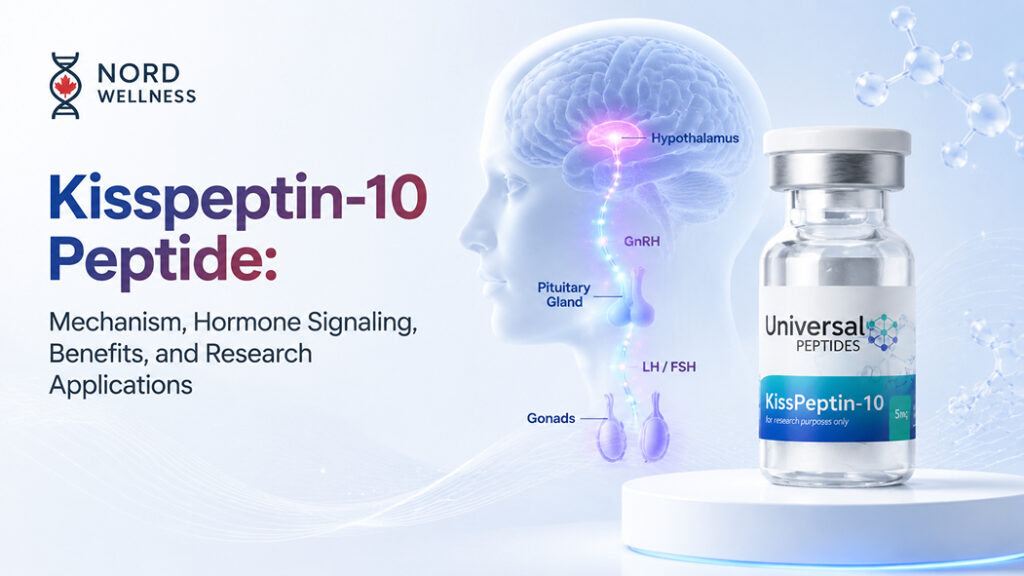
Jun
Kisspeptin-10 Peptide has gained increasing attention in endocrine and neuroscience research due to its central role in regulating reproductive hormone signaling. As a short active fragment of the kisspeptin system, it is widely studied for its influence on the hypothalamic–pituitary–gonadal (HPG) axis, a core regulatory pathway controlling puberty, fertility, and hormonal balance.
This article explores the mechanism of Kisspeptin-10, how it interacts with hormone signaling pathways, and why it is considered an important focus in reproductive and neuroendocrine research.
What Is Kisspeptin-10 Peptide?
Kisspeptin-10 is a decapeptide derived from the larger kisspeptin protein encoded by the KISS1 gene. It is the shortest biologically active fragment that retains strong receptor-binding activity, specifically targeting the KISS1 receptor (KISS1R / GPR54).
In research settings, Kisspeptin-10 is studied as a key regulator of reproductive hormone signaling rather than a structural hormone itself. Its primary importance lies in its ability to act as a signaling trigger upstream of gonadotropin-releasing hormone (GnRH).
From a biological perspective, Kisspeptin-10 functions as a molecular “switch” that helps initiate reproductive hormone cascades.
? Explore Kisspeptin-10 Peptide for research purposes at Kisspeptin-10 Peptide
How Kisspeptin-10 Peptide Works
The activity of Kisspeptin-10 is primarily mediated through its binding to the G-protein-coupled receptor KISS1R, located in the hypothalamus and other neuroendocrine tissues.
Once bound, it activates intracellular signaling pathways that ultimately stimulate the release of gonadotropin-releasing hormone (GnRH). This process leads to downstream secretion of:
- Luteinizing hormone (LH)
- Follicle-stimulating hormone (FSH)
These hormones are essential regulators of gonadal function in both male and female reproductive systems.
At the cellular level, Kisspeptin-10 activates phospholipase C (PLC) signaling, increasing intracellular calcium levels, which contributes to neuronal activation and hormone release.
This cascade makes Kisspeptin-10 one of the most direct upstream regulators of reproductive hormone activation currently known in biological research.
The Role of Kisspeptin-10 in Hormone Signaling
Kisspeptin-10 plays a central role in the hypothalamic–pituitary–gonadal (HPG) axis, which is the primary system controlling reproductive endocrine function.
Within this axis, Kisspeptin-10 acts as a gatekeeper signal:
- Environmental and metabolic signals influence kisspeptin neurons
- Kisspeptin-10 stimulates GnRH neurons in the hypothalamus
- GnRH triggers pituitary secretion of LH and FSH
- These hormones regulate gonadal activity and sex steroid production
This positioning makes Kisspeptin-10 a critical upstream modulator rather than a downstream effector.
Research also suggests that kisspeptin signaling integrates multiple physiological inputs, including:
- Energy balance and metabolic status
- Stress-related neuroendocrine signaling
- Pubertal timing regulation
- Fertility-related feedback loops
Because of this integrative role, Kisspeptin-10 is often studied as a “hub molecule” in reproductive biology.
? Explore Kisspeptin-10 Peptide for research purposes at Kisspeptin-10 Peptide
Potential Benefits of Kisspeptin-10 Research
It is important to note that current knowledge about Kisspeptin-10 comes primarily from preclinical and controlled research environments. Within these contexts, studies have explored several potential areas of interest:
1. Reproductive Hormone Regulation
Kisspeptin-10 is frequently studied for its ability to activate GnRH pathways, making it relevant to research on puberty initiation and reproductive axis function.
2. Fertility Research Models
Due to its upstream role in LH and FSH release, Kisspeptin-10 is investigated in models related to ovulation signaling, spermatogenesis regulation, and fertility disorders.
3. Neuroendocrine Signaling Studies
Beyond reproduction, kisspeptin neurons are also linked with brain regions involved in emotion and metabolic regulation, making Kisspeptin-10 relevant to broader neuroendocrine research.
4. Hormonal Feedback Mechanisms
Researchers study Kisspeptin-10 to better understand feedback loops between sex hormones (estrogen, testosterone) and hypothalamic signaling.
These areas highlight its importance as a research tool rather than a therapeutic compound.
Research Applications of Kisspeptin-10
Kisspeptin-10 is commonly used in experimental settings focused on:
- Hypothalamic neuron activation studies
- GnRH pulse frequency regulation experiments
- Puberty onset models in animals
- Endocrine feedback loop mapping
- Reproductive axis dysfunction research
It is particularly valuable in experimental endocrinology because it allows researchers to selectively stimulate the reproductive hormone cascade at a high level of control.
In laboratory models, Kisspeptin-10 is often used to observe acute hormonal responses, making it useful for time-dependent signaling studies.
Current Scientific Findings and Limitations
Current research strongly supports the role of Kisspeptin-10 as an upstream activator of reproductive hormone signaling. However, several limitations remain:
- Most data comes from animal and in vitro studies
- Human physiological responses vary depending on hormonal state
- Long-term systemic effects are not fully understood
- Kisspeptin signaling interacts with multiple overlapping pathways, making isolated interpretation complex
Additionally, kisspeptin activity can be influenced by sex hormones, metabolic state, and developmental stage, which adds variability to experimental outcomes.
Because of this, Kisspeptin-10 is still considered an active area of ongoing research rather than a fully characterized signaling tool.
? SEE MORE:
- How Kisspeptin-10 Peptide Works: Hormone Regulation, Signaling Pathways, and Research Insights
- Kisspeptin-10 Peptide Mechanism: Effects on GnRH Signaling and Endocrine Research
- Kisspeptin-10 Peptide Research: Current Studies, Scientific Interest, and Future Directions
- Kisspeptin-10 and Hormone Signaling: Understanding Its Role in Endocrine Function
FAQ About Kisspeptin-10 Peptide
Is Kisspeptin-10 a hormone?
No. It is a peptide signal that regulates hormone release indirectly by stimulating GnRH neurons.
What is the main function of Kisspeptin-10?
Its primary function is to activate the reproductive hormone axis via KISS1 receptor signaling.
Is Kisspeptin-10 used in clinical treatment?
Current use is primarily research-based. Clinical applications are still under investigation.
Why is Kisspeptin-10 important in research?
Because it sits at a key regulatory point controlling fertility and reproductive hormone signaling.
Does Kisspeptin-10 affect only reproduction?
While mainly associated with reproduction, research suggests potential interactions with metabolic and neuroendocrine systems.
Final Thoughts
Kisspeptin-10 Peptide represents one of the most important regulatory signals in reproductive endocrinology research. By acting upstream of GnRH activation, it provides researchers with a precise tool for studying hormonal signaling pathways, fertility regulation, and hypothalamic control mechanisms.
As scientific understanding continues to evolve, Kisspeptin-10 remains a key focus in studies exploring the intersection of neurobiology, endocrinology, and reproductive health.
Disclaimer
This content is provided by Nord Wellness for educational and research purposes only. Kisspeptin-10 Peptide is not approved for the diagnosis, treatment, cure, or prevention of any disease.



This was a very informative introduction to Kisspeptin-10 and its role in peptide research. I appreciated how the article explained the connection between receptor signaling and neuroendocrine communication in a way that was detailed yet easy to follow. The discussion around hormonal signa
Great article overall. Many peptide resources mention Kisspeptin-10 without providing much detail about the underlying biological mechanisms, but this article did a great job breaking down the science. I especially liked the explanation of signaling pathways and why this peptide continues to attract research interest.
Really enjoyed reading this article. The explanation of receptor interactions, cellular signaling, and neuroendocrine research applications was detailed enough to be educational while still remaining accessible to general readers. It’s refreshing to find peptide content that stays focused on the science and presents complex concepts in a clear and balanced way.
Pingback: How Kisspeptin-10 Peptide Works: Hormone Regulation, Signaling Pathways, and Research Insights - nordwellness.is
Pingback: Kisspeptin-10 Peptide Mechanism: Effects on GnRH Signaling and Endocrine Research - nordwellness.is
Pingback: Kisspeptin-10 Peptide Research: Current Studies, Scientific Interest, and Future Directions - nordwellness.is
Pingback: Kisspeptin-10 and Hormone Signaling: Understanding Its Role in Endocrine Function - nordwellness.is