

5-amino-1mq, Peptides, Weight Management & Metabolic Health
5-Amino-1MQ Metabolic Research: Mechanisms, Scientific Findings, and Future Directions
Summarize the article with:
 ChatGPT
 Claude
 Perplexity
 Google AI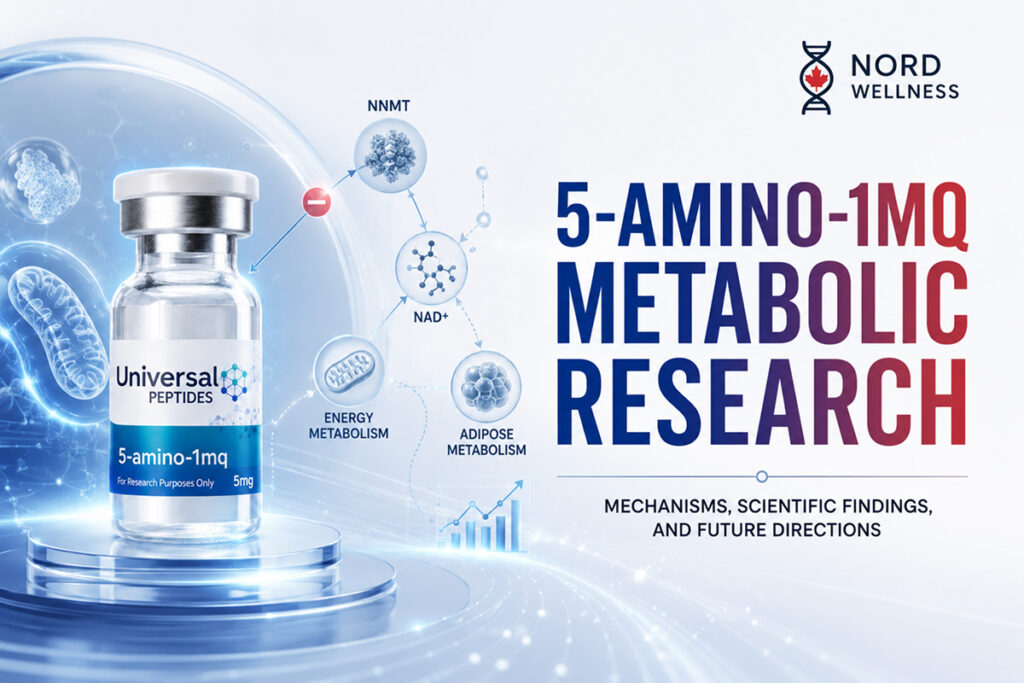
Aug
5-Amino-1MQ metabolic research focuses on nicotinamide N-methyltransferase (NNMT), an enzyme involved in nicotinamide metabolism, methyl-donor balance, and cellular energy regulation. Researchers study 5-Amino-1MQ because it inhibits NNMT and provides a way to examine how this pathway may influence NAD⁺, S-adenosylmethionine (SAM), adipocyte biology, lipid metabolism, and glucose regulation.
Current evidence remains primarily preclinical, including cell and animal studies. These findings help clarify possible metabolic mechanisms but do not establish therapeutic benefits or clinical effects in humans.
For additional research-focused information about metabolic compounds, explore Nord Wellness.
Why Researchers Study 5-Amino-1MQ
The main scientific interest in 5-Amino-1MQ comes from its ability to inhibit NNMT.
NNMT transfers a methyl group from SAM to nicotinamide, producing 1-methylnicotinamide (1-MNA) and S-adenosylhomocysteine (SAH). This reaction connects nicotinamide metabolism with methyl-donor pathways and has therefore attracted attention in metabolic research.
5-Amino-1MQ as an NNMT Inhibitor
5-Amino-1MQ, also known as 5-amino-1-methylquinolinium, is a small-molecule NNMT inhibitor.
In cultured adipocytes, researchers observed reductions in intracellular 1-MNA after treatment with 5-Amino-1MQ. Because 1-MNA is a direct product of NNMT activity, this finding supports the compound’s ability to inhibit the enzyme inside cells.
Researchers then began investigating how this inhibition may affect other metabolic processes, including NAD⁺ availability, SAM metabolism, lipid accumulation, and adipocyte function.
Why Adipose Tissue Is Important
NNMT is expressed in adipose tissue, and experimental studies have linked changes in its activity with adipocyte metabolism and energy regulation.
This makes adipose tissue an important model for 5-Amino-1MQ metabolic research, particularly when researchers examine lipid storage, adipocyte differentiation, and metabolic signaling.
Explore 5-Amino-1MQ for research purposes at 5-amino-1mq 5mg.
Metabolic Pathways Under Investigation
Research on 5-Amino-1MQ involves several interconnected metabolic pathways rather than one isolated mechanism.
| Research Area | Relationship to NNMT Inhibition | Evidence |
|---|---|---|
| 1-MNA production | NNMT inhibition reduces 1-MNA formation | Cell studies |
| NAD⁺ metabolism | May alter nicotinamide availability | Preclinical |
| SAM metabolism | May influence methyl-donor balance | Preclinical |
| Lipid accumulation | Reduced in adipocyte models | Cell studies |
| Body composition | Changes reported in obese mice | Animal studies |
| Glucose regulation | Improvements reported in mouse models | Animal studies |
| Insulin sensitivity | Changes observed in preclinical research | Animal studies |
These findings represent experimental observations rather than established human outcomes.
NNMT, Nicotinamide, and 1-MNA
NNMT converts nicotinamide into 1-MNA while consuming SAM.
Because nicotinamide also participates in NAD⁺ metabolism, reducing NNMT activity may change how cells use available nicotinamide. In cultured adipocytes, 5-Amino-1MQ reduced intracellular 1-MNA, providing a direct biochemical marker of NNMT inhibition.
This mechanism forms the foundation of 5-Amino-1MQ metabolic research.
NAD⁺ Metabolism
NAD⁺ plays an important role in cellular energy metabolism and redox reactions.
Because NNMT consumes nicotinamide, researchers have examined whether inhibiting the enzyme affects NAD⁺ availability. Some adipocyte studies reported increases in intracellular NAD⁺ after exposure to 5-Amino-1MQ.
However, NAD⁺ metabolism is regulated by multiple pathways. Therefore, it is more accurate to describe NAD⁺ changes as one possible downstream effect of NNMT inhibition rather than the compound’s entire mechanism.
SAM and Methyl-Donor Balance
NNMT also consumes SAM, a major cellular methyl donor.
By reducing NNMT activity, 5-Amino-1MQ may alter SAM availability. Experimental studies involving NNMT inhibition have reported changes in SAM and related metabolic processes.
This suggests that 5-Amino-1MQ may influence both nicotinamide metabolism and methyl-donor balance. Still, changes in SAM do not automatically prove specific epigenetic effects.
Lipid and Adipocyte Metabolism
Researchers have also examined how NNMT inhibition affects lipid accumulation.
In differentiating adipocyte models, 5-Amino-1MQ reduced lipid accumulation under specific experimental conditions. These results support further investigation into NNMT’s role in adipocyte biology and lipid storage.
However, cell-based findings should not be interpreted as evidence of fat-loss effects in humans.
Current Scientific Studies
Current 5-Amino-1MQ metabolic research is mainly based on biochemical experiments, cultured cells, and animal models.
Early Cell and Animal Research
Early studies showed that 5-Amino-1MQ could inhibit NNMT inside cultured adipocytes and reduce intracellular 1-MNA. Researchers also reported changes in NAD⁺, SAM, and lipid accumulation under experimental conditions.
The compound was later studied in mice with diet-induced obesity. Short-term experiments reported changes in body weight, adipose tissue mass, adipocyte size, and some metabolic markers.
These findings helped establish NNMT inhibition as a useful experimental strategy for studying metabolism.
However, these were short-duration animal studies and do not establish equivalent effects in humans.
More Recent Metabolic Research
Later animal studies expanded the research beyond body composition.
In diet-induced obese mice, researchers reported changes involving glucose tolerance, insulin sensitivity, fat-mass gain, and liver-related metabolic markers after treatment with 5A1MQ.
These findings suggest that NNMT inhibition may influence several metabolically active tissues rather than adipose tissue alone.
As a result, current research now includes areas such as:
- glucose regulation;
- insulin sensitivity;
- hepatic lipid metabolism;
- adipose tissue biology; and
- cellular energy regulation.
Evidence From Other NNMT Models
Research using other NNMT inhibitors and genetic models has also produced metabolic findings involving body weight, glucose handling, adipocyte function, and energy balance.
This broader evidence is useful because it helps researchers determine whether observed effects are linked to NNMT biology itself rather than only to one specific compound.
At the same time, different NNMT inhibitors can produce different outcomes. Therefore, researchers should avoid assuming that findings from one compound automatically apply to all NNMT-targeting molecules.
Limits of Current Evidence
Despite growing interest, current evidence does not establish 5-Amino-1MQ as a clinically validated intervention for obesity, insulin resistance, diabetes, or other metabolic conditions.
Most studies still involve:
- cultured cells;
- biochemical assays;
- rodent models; and
- relatively short experimental periods.
Human pharmacokinetics, long-term safety, clinical efficacy, and appropriate exposure ranges remain unclear.
For this reason, 5-Amino-1MQ should currently be viewed primarily as a research compound for studying NNMT-related metabolic pathways.
Explore 5-Amino-1MQ for research purposes at 5-amino-1mq 5mg.
Future Research Opportunities
Future 5-Amino-1MQ metabolic research will need to clarify which metabolic effects result directly from NNMT inhibition and how these effects vary between tissues.
Clarifying the Mechanism
NNMT connects nicotinamide metabolism with NAD⁺, SAM, methylation, and energy regulation.
Future research may combine metabolomics, transcriptomics, and other molecular approaches to determine which downstream changes occur directly after NNMT inhibition and which are secondary responses.
This could help clarify whether changes in NAD⁺, SAM, adipocyte metabolism, and glucose regulation share a common mechanism or represent separate biological effects.
Tissue-Specific Effects
Much of the existing research focuses on adipose tissue. However, recent animal findings involving liver metabolism suggest that NNMT may influence multiple metabolically active tissues.
Future studies could compare NNMT inhibition across:
- adipose tissue;
- liver;
- skeletal muscle;
- kidney; and
- other metabolic organs.
This may help researchers understand where the compound produces its most significant biological effects.
Long-Term Safety and Selectivity
Short-term experiments cannot determine the consequences of prolonged NNMT inhibition.
Future studies should evaluate whether long-term suppression of NNMT changes nicotinamide metabolism, methyl-donor balance, or other cellular systems.
Researchers also need to investigate selectivity carefully. Observed metabolic effects may result from NNMT inhibition, off-target activity, or interactions between several pathways.
Translational Research
One of the largest gaps in 5-Amino-1MQ metabolic research is translation from animal models to humans.
Rodent metabolism differs from human metabolism, so changes in adiposity, glucose regulation, or liver lipids in mice cannot be assumed to occur in people.
Future translational studies would need to clarify pharmacokinetics, pharmacodynamics, safety, biomarkers, and exposure-response relationships before stronger conclusions could be made.
Explore the complete guide to 5-Amino-1MQ mechanisms, metabolic research, benefits, and scientific applications
FAQ About 5-Amino-1MQ Metabolic Research
What is 5-Amino-1MQ metabolic research?
5-Amino-1MQ metabolic research investigates how NNMT inhibition may influence nicotinamide metabolism, 1-MNA, NAD⁺, SAM, adipocyte biology, lipid metabolism, glucose regulation, and energy balance.
What does 5-Amino-1MQ target?
5-Amino-1MQ has been studied as an inhibitor of nicotinamide N-methyltransferase (NNMT), an enzyme that converts nicotinamide into 1-MNA using SAM as a methyl donor.
Does 5-Amino-1MQ affect NAD⁺?
Some preclinical adipocyte studies have reported changes in intracellular NAD⁺ following NNMT inhibition. However, NAD⁺ regulation involves multiple pathways, so the effect should not be viewed as universal.
What has research found about lipid metabolism?
Cell studies have reported reduced lipid accumulation during adipocyte differentiation. Animal studies have also examined changes in adipose tissue and body composition. These findings remain preclinical.
Has 5-Amino-1MQ been studied for glucose metabolism?
Yes. Animal studies have reported changes in glucose tolerance and insulin sensitivity in diet-induced obesity models. These findings do not establish equivalent effects in humans.
Is the research limited to body weight?
No. Researchers also investigate NAD⁺ and SAM metabolism, adipocyte biology, glucose regulation, insulin sensitivity, liver metabolism, and cellular energy pathways.
Are human metabolic benefits established?
No. Current evidence is predominantly preclinical. Cell and animal findings do not establish human safety, efficacy, or clinical metabolic benefits.
Final Thoughts
5-Amino-1MQ metabolic research focuses on NNMT and its relationship with nicotinamide metabolism, NAD⁺, SAM, adipocyte biology, glucose regulation, and energy balance.
Current cell and animal studies show that NNMT inhibition can produce measurable metabolic changes, including reduced 1-MNA, altered lipid accumulation, and changes in body composition, glucose handling, insulin sensitivity, and liver-related markers.
However, the evidence remains preclinical. Future studies should focus on tissue-specific mechanisms, long-term NNMT inhibition, compound selectivity, and translational research.
For additional research-focused information about 5-Amino-1MQ and related compounds, explore Nord Wellness.
Disclaimer
This content is provided by Nord Wellness for educational and research purposes only. 5-amino-1mq 5mg is not approved for the diagnosis, treatment, cure, or prevention of any disease.



Really interesting overview of 5-Amino-1MQ and its connection to metabolic research. I liked how the article focuses on the research mechanisms rather than presenting early findings as established outcomes. It would be interesting to see more detail on which metabolic pathways are currently being investigated.
I found this article helpful for understanding why 5-Amino-1MQ has attracted attention in metabolic research. The explanation gives useful context around the biological processes being studied without overstating the available evidence. I’d be interested in seeing a comparison of findings from laboratory models and human research.
Appreciate the research-focused approach to this emerging topic. There is a lot of information about 5-Amino-1MQ online, so having its potential role in metabolic research explained with some scientific context makes the subject easier to evaluate. A follow-up discussing the current limitations and unanswered questions would be valuable.