

Growth Hormone Inducing Peptides, hCG, Peptides
hCG Nasal Spray: Intranasal Delivery and Research Considerations
Summarize the article with:
 ChatGPT
 Claude
 Perplexity
 Google AI
May
Human chorionic gonadotropin, commonly known as hCG, is a glycoprotein hormone studied in reproductive biology, endocrine signaling, and hormone–receptor interaction. Although discussions in the peptide research space sometimes mention hCG, researchers do not classify it as a simple short-chain peptide. Instead, hCG functions as a structurally complex hormone composed of alpha and beta subunits with attached carbohydrate chains.
Researchers commonly use the term hCG nasal spray to describe intranasal delivery approaches in which compounds are administered through the nasal cavity rather than through injection or oral routes. However, this topic requires careful scientific framing. Intranasal delivery may be useful for certain peptides and proteins, but absorption, stability, molecular size, formulation design, and regulatory context all strongly affect research interpretation.
At Nord Wellness, we develop educational content to help researchers and readers understand peptide-related science through accurate, transparent, and responsible research-focused language.
What Is hCG Nasal Spray in Research Context?
In research settings, hCG nasal spray is discussed as a potential delivery format explored for formulation and administration studies. It should not be interpreted as a clinically proven, approved, or universally effective substitute for conventional hCG delivery methods.
Human chorionic gonadotropin (hCG) is a glycoprotein hormone naturally produced by trophoblast cells during early pregnancy. Researchers commonly study its role in endocrine signaling through its interaction with the luteinizing hormone/choriogonadotropin receptor (LHCGR).
Because hCG is a large and structurally complex molecule, researchers consider its delivery more technically demanding than many low-molecular-weight compounds. Scientific literature describes hCG as a highly glycosylated glycoprotein consisting of multiple subunits, which may create additional formulation and absorption challenges in experimental delivery systems such as nasal administration.
From a research perspective, hCG nasal spray may be discussed in relation to:
| Research Focus | Why It Matters |
|---|---|
| Intranasal absorption | Evaluates whether macromolecules can cross or pass through nasal mucosa |
| Protein stability | hCG may be sensitive to degradation or improper formulation |
| Bioavailability | Determines how much active compound reaches systemic circulation |
| Delivery comparison | Helps compare nasal, injectable, and other routes |
| Formulation science | Examines excipients, pH, preservatives, and absorption enhancers |
| Regulatory interpretation | Prevents unsupported claims around non-approved delivery forms |
The key point is that researchers and educators should frame hCG nasal spray as a research or formulation topic rather than as a casual-use product or a guaranteed delivery method.
? Explore hCG Peptide for research purposes at hCG peptide
Intranasal Peptide Delivery Mechanisms
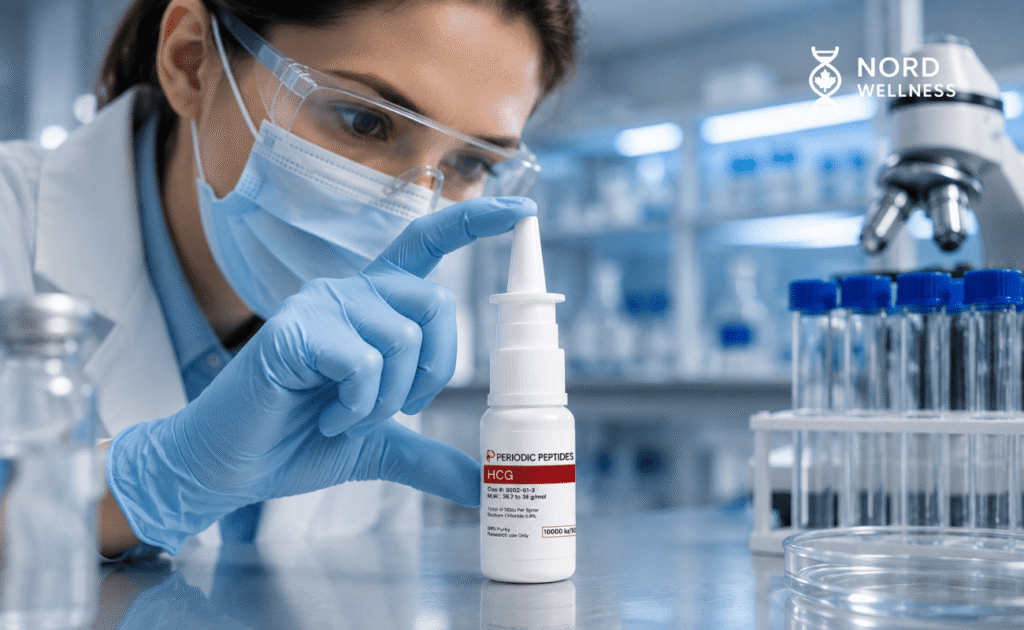
Researchers study intranasal delivery because the nasal cavity contains a dense vascular network and an easily accessible mucosal surface. For certain compounds, this route may support faster absorption while also bypassing degradation processes commonly associated with the gastrointestinal tract. Scientific reviews on intranasal administration have identified the nasal route as a potential delivery approach for select peptides and proteins, particularly when oral bioavailability is limited.
Despite these advantages, intranasal peptide delivery remains technically challenging. The nasal environment includes several natural defense mechanisms, such as mucus barriers, enzymatic activity, mucociliary clearance, and short retention time within the nasal cavity. Together, these factors may limit absorption efficiency and make formulation strategy a critical aspect of research and development.
| Mechanism or Barrier | Research Explanation |
|---|---|
| Nasal mucosa contact | The compound must remain in contact with the nasal surface long enough for absorption |
| Mucociliary clearance | The nose naturally clears particles and fluids, limiting exposure time |
| Enzymatic degradation | Peptides and proteins may be broken down by enzymes in nasal tissue |
| Molecular size | Larger molecules generally face greater absorption challenges |
| Formulation design | pH, tonicity, viscosity, and excipients can affect delivery performance |
| Absorption enhancers | Some studies explore enhancers, but safety and irritation must be evaluated |
Intranasal delivery may be more achievable for smaller peptides when supported by appropriate formulation strategies. In contrast, large glycoprotein hormones such as hCG present additional challenges due to their molecular size and structural complexity, both of which can restrict passive absorption across the nasal mucosa.
As a result, research involving hCG nasal spray must evaluate more than the biological activity of the hormone itself. Investigators also need to examine whether the delivery system can maintain molecular stability, preserve functional integrity, and enable sufficient absorption for measurable biological availability.
Absorption and Bioavailability Considerations
Bioavailability describes the proportion of a compound that reaches systemic circulation in an active and usable form. In studies involving intranasal peptides and proteins, bioavailability remains one of the central factors researchers evaluate when assessing delivery effectiveness.
Intranasal administration is often considered promising because it may bypass first-pass liver metabolism and reduce exposure to gastrointestinal degradation. Even so, scientific reviews consistently note that biological barriers within the nasal cavity — including mucosal defenses and enzymatic activity — can significantly limit the bioavailability of peptide- and protein-based compounds delivered through the intranasal route.
For hCG specifically, several factors may influence absorption:
| Factor | Impact on hCG Nasal Spray Research |
|---|---|
| Molecular size | Larger glycoproteins may have difficulty crossing nasal mucosa |
| Glycosylation | Carbohydrate chains affect stability, folding, and biological behavior |
| Formulation pH | Incorrect pH may reduce stability or cause irritation |
| Enzymatic exposure | Proteolytic enzymes may affect protein integrity |
| Residence time | Short nasal contact time may reduce absorption |
| Delivery device | Spray droplet size and deposition pattern can influence results |
Due to its structural complexity, hCG presents greater delivery challenges than many smaller research peptides. Researchers therefore cannot assume that intranasal administration provides bioavailability comparable to injectable hCG formulations. Clinical trial registry data has also referenced comparative bioavailability studies involving hCG absorption, emphasizing that both the rate and extent of absorption continue to be important areas of investigation in hCG delivery research.
To maintain scientific accuracy, discussions surrounding hCG nasal spray should avoid making definitive claims about bioavailability unless those statements are supported by validated pharmacokinetic evidence.
? Explore hCG Peptide for research purposes at hCG peptide

hCG Delivery Methods in Laboratory Studies
In both laboratory and clinical research settings, hCG is most commonly studied in injectable forms, particularly when consistent systemic exposure and predictable pharmacokinetic profiles are required. Injectable administration is frequently preferred because protein-based hormones may demonstrate limited stability and reduced absorption efficiency when delivered through oral or mucosal routes.
Research discussions around hCG delivery may include:
| Delivery Method | Research Context |
|---|---|
| Subcutaneous injection | Commonly used for systemic delivery and pharmacokinetic comparison |
| Intramuscular injection | Historically used in certain clinical and research contexts |
| Intranasal formulation | Studied as a potential non-invasive route, but absorption must be validated |
| Oral/sublingual forms | Often problematic due to degradation and lack of reliable evidence |
| Assay-based models | Used to measure hormone activity, receptor activation, or serum levels |
A pharmacokinetic study evaluating highly purified hCG and recombinant hCG after single subcutaneous administration in healthy women describes hCG as a dimeric glycoprotein hormone and examines its bioavailability following injection. This type of research illustrates why injectable administration is commonly used as a reference standard in studies involving hCG delivery.
By comparison, intranasal formulations require more extensive evaluation across multiple factors, including absorption efficiency, molecular stability within the formulation, mucosal compatibility, and the preservation of biological activity after administration.
Nasal Spray vs Other Delivery Forms
From a research perspective, nasal spray delivery has potential advantages, but also major limitations. It may be more convenient and non-invasive, but convenience does not equal reliable systemic absorption.
| Delivery Form | Potential Research Advantage | Key Limitation |
|---|---|---|
| Nasal spray | Non-invasive, may avoid gastrointestinal degradation | Bioavailability may be low or variable |
| Subcutaneous injection | More predictable systemic exposure | Invasive route |
| Intramuscular injection | Historically established for some protein hormones | Invasive and less convenient |
| Oral form | Easy administration | Protein hormones may degrade in digestion |
| Sublingual/oral drops | Marketed in some wellness contexts | Evidence and regulatory concerns are significant |
This distinction is particularly important because hCG has frequently been misrepresented in commercial weight-loss products, including sprays, pellets, and oral drops. The FDA has advised consumers to avoid HCG products marketed for weight loss and notes that these products are commonly promoted in forms such as oral drops, pellets, and sprays.
The agency has also clarified that certain injectable hCG medications are approved for specific medical indications under professional supervision. However, the FDA does not approve oral or sublingual hCG products for weight loss or for any other intended use.
Within research peptide discussions, maintaining this distinction is essential. hCG nasal spray should not be presented as a weight-loss solution, a wellness trend, or a guaranteed substitute for established hCG delivery methods. Any discussion should remain grounded in scientific research, formulation challenges, and evidence-based pharmacokinetic considerations.
Safety and Research Limitations
The safety profile and research limitations associated with hCG nasal spray depend on several factors, including formulation quality, route-specific tolerability, absorption characteristics, and overall study design. Intranasal delivery involves far more than simply placing a compound into a spray formulation. Because the nasal mucosa is highly sensitive, variables within the formulation may significantly influence irritation potential, absorption efficiency, molecular stability, and dosing consistency.
Important limitations include:
| Limitation | Why It Matters |
|---|---|
| Limited route-specific data | hCG nasal delivery has less established evidence than injectable routes |
| Variable absorption | Nasal anatomy, mucus, and clearance can affect results |
| Protein degradation | hCG may lose integrity if formulation conditions are poor |
| Dose inconsistency | Spray volume, droplet size, and deposition may vary |
| Regulatory concerns | Non-approved hCG spray claims can create compliance risks |
| Misuse potential | hCG is often incorrectly marketed for weight loss |
Intranasal delivery reviews emphasize that peptide and protein delivery through the nasal route remains technically challenging. Absorption enhancers and formulation strategies may improve delivery in some cases, but they also introduce questions around safety, irritation, and long-term mucosal effects.
In research-focused content, hCG nasal spray should be discussed with clear boundaries:
| Avoid Saying | Better Research Framing |
|---|---|
| “hCG nasal spray works for weight loss” | hCG nasal spray is a delivery concept studied in formulation and absorption research |
| “Nasal hCG is better than injection” | Intranasal delivery may be less invasive, but bioavailability must be validated |
| “hCG spray is easy and effective” | Nasal delivery of glycoprotein hormones may face absorption and stability challenges |
| “hCG is just another peptide spray” | hCG is a complex glycoprotein hormone, not a simple peptide |
| “Spray delivery guarantees systemic effects” | Systemic exposure depends on formulation, absorption, and pharmacokinetic evidence |
Responsible scientific writing should keep the distinction clear: intranasal delivery is a research route, not proof of effectiveness by itself.
FAQ – HCG Nasal Spray
What is hCG nasal spray?
hCG nasal spray refers to the concept of delivering human chorionic gonadotropin through the nasal route. In a research context, it is usually discussed as a formulation and delivery-method topic, not as a proven consumer product.
Is hCG a peptide?
Researchers sometimes discuss hCG in peptide research spaces, but they more accurately classify it as a glycoprotein hormone. hCG contains alpha and beta subunits with attached carbohydrate chains, which make it larger and more structurally complex than a typical short-chain peptide.
How does intranasal peptide delivery work?
Intranasal delivery works by applying a compound to the nasal mucosa, where the compound may absorb through local tissue and enter circulation. However, peptides and proteins encounter several barriers, including enzymatic degradation, mucociliary clearance, molecular size limitations, and short residence time.
Is hCG nasal spray bioavailable?
Bioavailability depends on formulation, molecular stability, nasal absorption, and experimental conditions. Because hCG is a large glycoprotein hormone, researchers cannot assume reliable absorption without pharmacokinetic evidence.
How does hCG nasal spray compare with injections?
Injectable hCG delivery is generally used when predictable systemic exposure is required. Nasal spray delivery may be less invasive, but it requires validation for absorption, stability, and biological activity.
Is hCG nasal spray used for weight loss?
Companies and marketers should not promote hCG as a weight-loss product. The FDA advises consumers to avoid HCG weight-loss products and notes that manufacturers often market HCG products sold as drops, pellets, and sprays with unapproved claims.
What are the main research limitations of hCG nasal spray?
Main limitations include uncertain bioavailability, protein stability challenges, potential mucosal irritation, variable spray deposition, limited route-specific evidence, and regulatory concerns around unsupported claims.
Why is nasal delivery studied for peptides and proteins?
Nasal delivery is studied because it may offer a non-invasive route and may avoid gastrointestinal degradation. However, peptide and protein absorption through the nasal mucosa remains challenging and highly formulation-dependent.
Final Thoughts
Researchers best understand hCG nasal spray as a topic related to intranasal delivery, formulation science, and bioavailability rather than as a guaranteed delivery method or a general-use wellness product. Because hCG is a complex glycoprotein hormone, researchers must carefully evaluate nasal delivery for absorption, stability, receptor activity, and regulatory considerations.
For readers interested in peptide science, endocrine signaling, and responsible research education, Nord Wellness provides content focused on accuracy, transparency, and science-based interpretation.
Disclaimer
This content is provided by Nord Wellness for educational and research purposes only. hCG peptide is not approved for the diagnosis, treatment, cure, or prevention of any disease.


Really informative article with a clear explanation of HCG nasal spray delivery and the research considerations behind it. I appreciated that the content focused on both the science and the practical aspects of intranasal delivery instead of just highlighting convenience. The discussion about absorption pathways was especially interesting. Do you think intranasal delivery methods could become more common for peptide-based research in the future?
Excellent breakdown of a topic that many readers probably don’t fully understand yet. I liked how the article explained the research considerations in a balanced and educational way without making exaggerated claims. The comparison between intranasal delivery and more traditional methods was especially thought-provoking. It would be interesting to see more discussion about how delivery methods influence long-term effectiveness and user experience.
This article did a great job simplifying the science behind HCG nasal sprays while still keeping the information detailed and professional. I appreciated the focus on research and safety considerations because many articles online tend to skip those important aspects. The explanation of intranasal absorption made the topic much easier to follow. Have researchers identified any major differences in effectiveness between nasal delivery and injectable formats for HCG-related compounds?